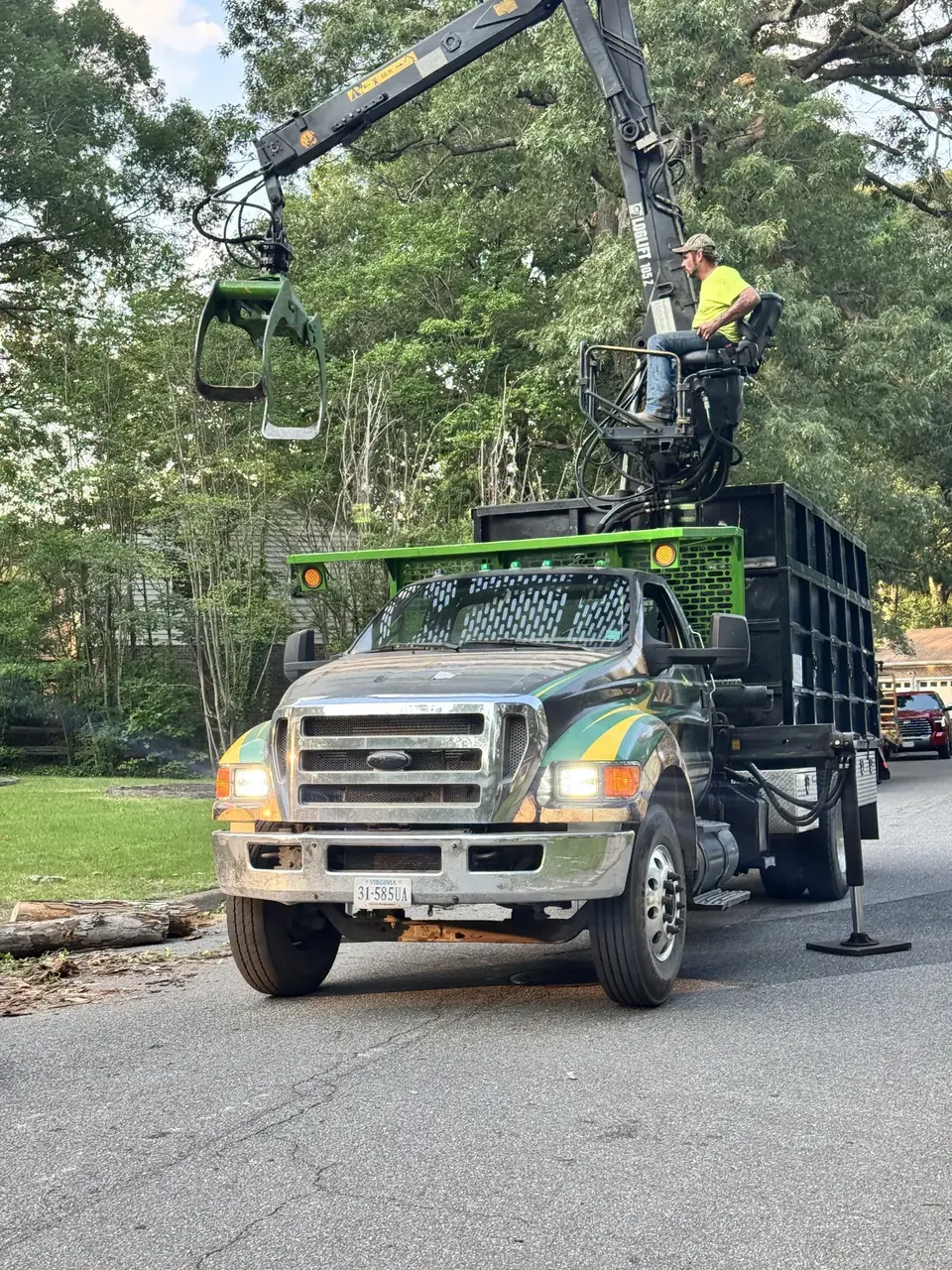
Where Your Tree Goes After We Take It Down
15 loblolly pines and a monster red oak out of one Great Neck backyard — and the wood chain that runs out of Hampton Roads.
By Mike Campbell, Owner & Lead ClimberPublished
- The job
- 15 loblolly pines + 1 massive red oak — Great Neck, Virginia Beach
- Hauled off
- Every stick — right down to the stump mulch
- The myth
- A big yard tree is a lumber “gold mine” — it almost never is
- Where it went
- Chips, pulpwood, firewood — the West Point & Franklin mills and the Southampton power station
- At the mill
- Semi-towed chip trailers tip up on their tail; a grapple crane grabs a whole bunk of logs
- The one exception
- Stump grindings — wood mixed with dirt, can’t be recycled clean
Quick answer
When we take a tree out of your yard, almost none of it goes to waste. The brush and smaller wood get chipped — some of those chips get burned for electricity at a biomass power station, the rest become mulch. The straight trunks go to a paper mill as pulpwood. The big solid chunks get cut into firewood. The only thing that can’t be recycled clean is the stump grindings, because grinding mixes the wood with dirt. What your tree almost never becomes is lumber — and that surprises people every time.
This one started as a straightforward tree removal in Great Neck, right here in Virginia Beach — fifteen loblolly pines and one absolute monster of a red oak, all coming out of a single backyard. The homeowner wanted it gone clean, so we hauled off every stick — right down to the stump mulch. That one job is a perfect map of where a removed tree actually ends up, so let me walk you through it.
“I’ve got a gold mine in my backyard,” right?
It happens on a lot of estimates. On that Great Neck job the homeowner looked up at that red oak — easily three-plus feet through the trunk — and figured the wood in it had to be worth a fortune, that I should be paying him for the lumber. I get it. It’s a huge tree. But here’s the honest truth of my trade: virtually no residential tree makes good lumber.
A sawmill wants a clean, straight log grown in a forest, where the tree stretched up for light and self-pruned its lower limbs. Your yard tree grew in the open. It’s full of knots, cavities, twists, and cracks from spreading out instead of up.1
And then there’s the killer: metal. Yard trees are full of it — nails, fence staples, old clothesline hooks, a treehouse lag bolt somebody sank in 1985, even grown-over barbed wire. The first few feet off the ground are the worst.1 One hidden nail can destroy a sawmill blade or a veneer knife in a heartbeat, so most mills won’t even risk a yard tree. Add in the small volume from one or two trees and the cost of hauling it, and the “gold mine” is a liability, not a payday.
Your tree still has real value — just not as boards. It’s worth something as pulpwood, biomass, mulch, and firewood. That’s the chain those fifteen pines and that oak went into.
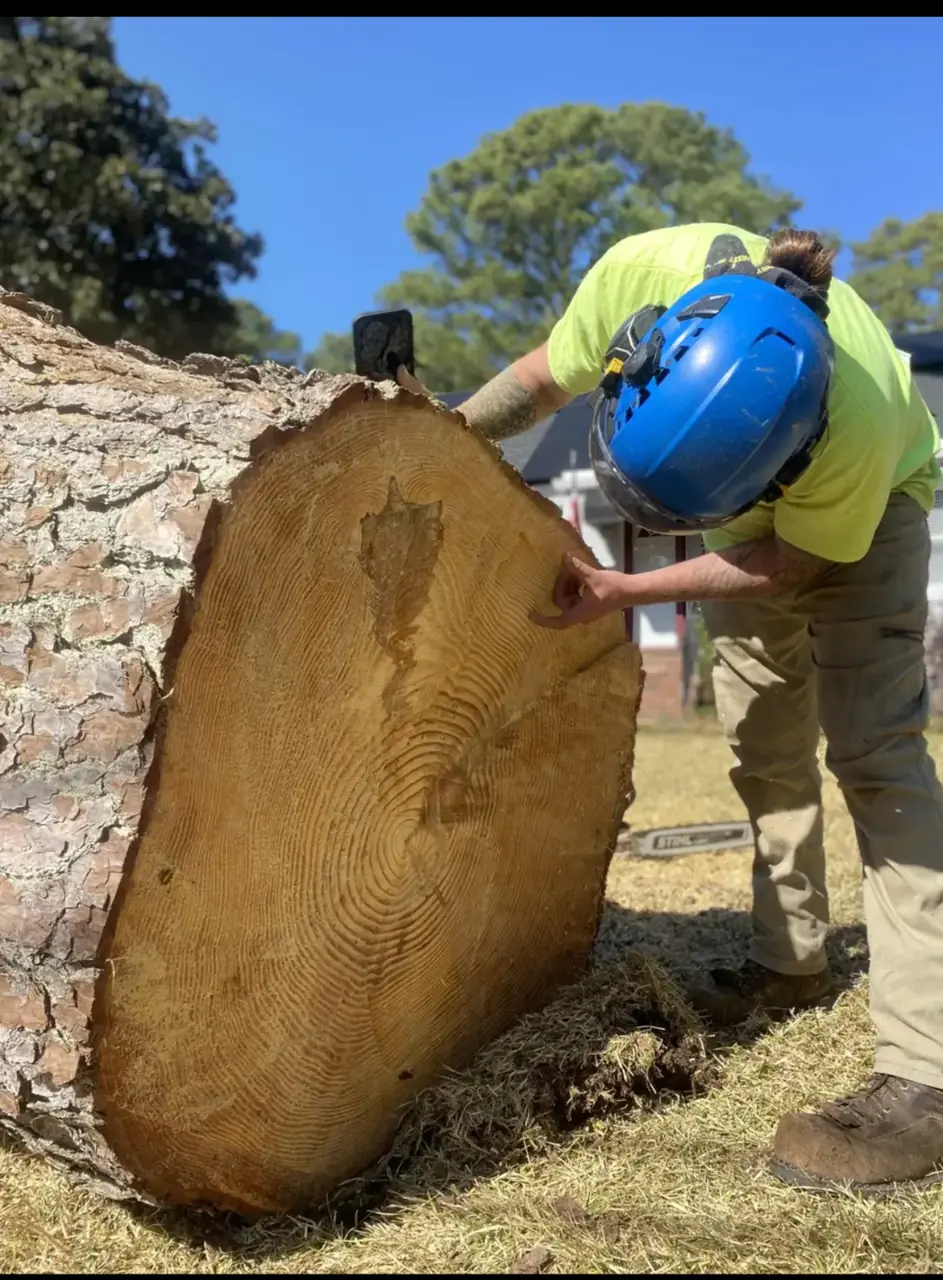
So where does it actually go?
Every tree we take down gets sorted on the spot — those Great Neck pines and the oak all split up the moment they hit the ground. Different parts of the same tree head down completely different roads:
Chips → biomass power
The brush and smaller wood run through the chipper. A share of those chips gets trucked to a wood-fired power station and burned in the boilers to make electricity. It’s literally your tree keeping the lights on.
Chips → mulch
The rest of the chips become mulch — the same stuff you buy by the bag, made from clean wood that holds moisture and knocks down weeds around beds and trees.
Logs → pulpwood
The straight trunks get graded as pulpwood and sent to a paper mill, where they’re cooked down to fiber for cardboard, kraft paper, and even the fluff pulp in diapers and wipes.
Chunks → firewood
The big, solid, knotty pieces that aren’t worth hauling to a mill get bucked into firewood lengths — split, seasoned, and burned. Nothing fancy, but nothing wasted.
The word that ties it together is pulpwood. In the timber world there are basically three grades: a sawlog (clean and straight, becomes lumber), pulpwood (smaller, crooked, or knotty wood that gets chipped and cooked into paper fiber), and chips or biomass (everything else — fuel). Almost everything that comes out of a yard — including fifteen open-grown loblollies and a limby backyard oak — is pulpwood-grade or lower. That’s not an insult to your tree; it’s just what open-grown wood is good for, and there’s a whole industry built to use it.
The market, the mills, and the loggers who run it
Southeastern Virginia is paper-mill country, and that’s not an accident — the region is blanketed in fast-growing Southern pine, which is exactly what these mills want. The loblolly pine is the workhorse of it, and it’s the same tree that shades half the yards in Virginia Beach.2 A few big buyers anchor the whole market our wood flows into:
West Point — Smurfit WestRock
A big containerboard mill on the York River. It cooks pulpwood and sawmill chips into the brown kraft board that becomes corrugated boxes. Mills like this buy fiber as a mix of roundwood (whole logs) and chips — one WestRock Virginia mill reports buying roughly half its fiber as pulpwood and half as chips.3
Franklin — International Paper
The old Franklin paper mill was the heart of that town until it closed in 2010 and cost more than a thousand jobs. It reopened as a fluff-pulp mill — the soft absorbent fiber inside diapers, wipes, and feminine products — running on the Southern pine that grows all around it.4
Southampton — Dominion biomass power station
Dominion converted its old Southampton coal plant to burn waste wood back in 2013. It runs on the chips and scraps left over from timbering, makes about 51 megawatts of electricity, and the three converted stations burn close to 600,000 tons of wood biomass a year — supporting a hundred-plus local logging and trucking jobs.5
If you ever get to watch a load come into one of these yards, it’s a different scale than anything in your driveway. The chip trailers — hauled in behind semi tractors — don’t get shoveled out. The whole rig pulls onto a hydraulic truck dumper, the front end gets hoisted, and the trailer stands up on its tail at close to a 60-degree angle until the chips avalanche out the back into the pit.6 The log trucks get worked by a giant grapple crane — a radial or pedestal rig that swings out over the trailer, drops a claw the size of a small car, and snatches a whole bunk of logs in one bite, decking it in seconds. One of those cranes will make around forty picks an hour.7 It’s the same rigging discipline we use to crane a tree out of a backyard — just scaled up to move wood by the ton.
This is a commodity market, and it moves. The price a mill pays per ton of pulpwood swings with demand, the weather, and how many loggers are cutting that month — and a wet winter that bogs down the woods can spike prices as fast as a mill slowdown can crater them. The old man I offload to doesn’t romanticize any of it. The way he puts it: it’s tonnage and diesel. He lives and dies by the price the mill is posting that week and how far he’s got to haul to hit it. When pulp prices are down, that “worthless” yard wood I’m handing off is barely worth the fuel to move — and when they’re up, everybody’s cutting.
Logging vs. arboriculture — what’s the difference?
People mix these up all the time, so let me draw the line clearly. A logger is in the volume business. He’s out in the woods dropping acres of timber, hauling it to the mill by the ton, and his whole world is efficiency and price-per-ton. He doesn’t need to worry about a swing set under the tree or a service drop three feet off the top, because there’s nothing out there but more trees.
An arborist — that’s us — is in the exact opposite business. Every one of those fifteen pines had a house, a fence, or a power line inside its reach. We take down one tree at a time, surrounded by the most expensive things you own, and we climb it or crane it out in controlled pieces so nothing below it gets touched. It’s slow, technical, rigging-and-safety work governed by its own standards.
Both jobs end with a log on the ground — but one is forestry and the other is closer to surgery. We’re arborists. Once we’ve gotten your tree down safely, we’re the front door of the logger’s supply chain — the wood we hand off is the same wood that feeds those mills. If you want the deeper version of why the safe-removal side is a licensed, insured, standards-driven trade, that’s in our OSHA & safety write-up, and the pricing side is in our affordable tree work guide.
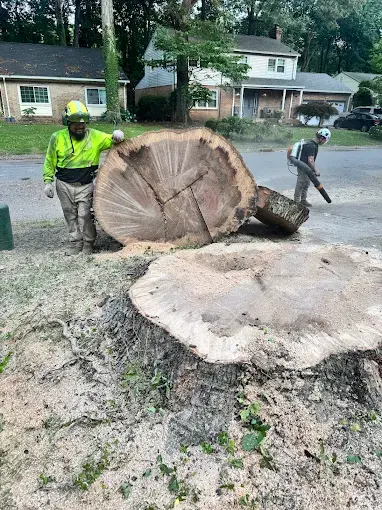
Stump grindings — and why pine is a problem
Everything I’ve described so far — chips, pulpwood, firewood — is clean wood that has a home. There’s exactly one product from a removal that can’t go into that chain: the stump grindings.
When we grind a stump, the teeth are chewing wood and soil at the same time, so what’s left is a pile of chips mixed with dirt, grit, and rocks. No mill wants that — the dirt is death on their equipment — and it doesn’t make good bagged mulch either. So it stays on site or gets hauled off as fill. On the Great Neck job, that’s exactly where the grindings went — hauled off with everything else, which is what the homeowner wanted.
Here’s the useful part, though: if the stump was the right hardwood, that wood-and-soil mix actually breaks down into pretty good compost and garden soil over a season or two. It’s already got the dirt built in. A lot of folks just rake it into a bed and let it cook.
The catch is the species. Pine and other softwoods turn acidic as they break down, and fresh grindings of any wood will pull nitrogen out of the soil while they rot. So pine grindings — like the pile those fifteen loblollies left — are fine around acid-loving stuff like azaleas or in a back corner, but keep them out of the vegetable garden unless you’ve let them age and balanced them out. Right wood, right spot: free soil. Wrong wood in the wrong bed: a season of stunted tomatoes.
What we do with your wood — and your choice
I’m Mike Campbell, and I own Art-is-Tree. When we clear your tree, you’ve got a say in where the wood goes. Plenty of customers want us to leave the chips for their own mulch, or buck the trunk into firewood rounds and stack it — and that’ll knock money off your bill, because it’s wood we don’t have to haul. We get into that trade-off in our guide to affordable tree work. This owner wanted a clean slate, so all of it left with us.
Whatever you don’t keep doesn’t go to a landfill. It goes into the chain you just read about — chipped for mulch and biomass, or hauled off as pulpwood into the same market that feeds the mills in West Point and Franklin. It’s one of the parts of this job I actually like: a hazard tree coming off your house on Monday is cardboard, mulch, or electricity by the end of the month.
We handle tree removal, stump grinding, and land clearing across Virginia Beach — Great Neck, Kings Grant, Alanton, and the rest — and all of Hampton Roads. The wood is always accounted for.
Sources
1. UMass Building & Construction Technology, “Urban Wood Waste: Maximizing Log Value for the Sawmill Market” — embedded metal, knots/defects, and small volumes make yard trees poor sawlogs.
2. Virginia Department of Forestry, Pine Management, and Virginia Places, Trees of Virginia — loblolly pine is the dominant, commercially important pine across Virginia’s Coastal Plain and Tidewater.
3. Virginia Economic Development Partnership, “The Future of Manufacturing in America: WestRock” — WestRock’s Virginia paperboard operations and roundwood/chip fiber mix.
4. United Steelworkers, on the Franklin, VA mill’s 2010 closure and fluff-pulp reopening.
5. Dominion Energy, Biomass Fuel Facilities, and Virginia Places, Biomass Energy in Virginia — Southampton coal-to-biomass conversion, ~51 MW, and regional wood-fuel tonnage.
6. Montague Legacy Group, Hydraulic Truck Dumpers & Trailer Tippers, and Drax, “This is how you unload a wood chip truck” — semi-towed chip trailers tip to roughly 60° on a hydraulic dumper to unload.
7. Konecranes, Woodyard Cranes, and Andritz, Log-Yard Cranes — radial/pedestal grapple cranes unload a full bunk of logs at a time.
We’ll handle the tree — and the wood.
Free, written, and itemized — for one pine or fifteen, anywhere in Virginia Beach or Hampton Roads. Keep the chips and firewood, or let us haul it into the chain. Your call.
Get a Free Estimate