The Bid We Lost on Price and Won on Paper
A landscaping company underbid us by $2,240 on a Chic’s Beach rental property. The owner hired us anyway — after he read both certificates of insurance and saw what one of them didn’t cover.
By Mike Campbell, Owner & Lead Climber, Art-is-Tree LLCPublished
Multiple big pines and one massive oak
Chic’s Beach sits right on the Chesapeake Bay, and the trees up there live a hard life — constant salt air off the water, wind with nothing to break it, and lots that were platted long before anyone thought about where a seventy-foot pine would eventually need to land. This was a rental property with several large pines and one genuinely massive oak, all of them close to the structure — the kind of tree removal in Virginia Beach that has to be rigged and lifted, not felled.
We walked it, wrote the number, and sent it over. A landscaping company came in $2,240 under us. On a job that size that’s not a rounding error — that’s a real amount of money, and I fully expected to lose it.
The owner called back and asked both of us for a certificate of insurance. That’s the whole story. He wasn’t being difficult and he wasn’t shopping for a reason to pay more. He owns rental property, which means he already carries his own policies, he has read a certificate of insurance before, and he understands something most homeowners never have to think about: when an uninsured crew gets hurt on your property, the exposure doesn’t stay with the contractor.
He read both certificates. Then he paid the extra $2,240 on purpose.
- Location
- Chic’s Beach, Virginia Beach — Chesapeake Bay front
- Scope
- Multiple large pines plus one massive oak, all near the structure
- Property type
- Rental property — owner carries his own liability
- The competing bid
- $2,240 below ours, from a landscaping company
- What decided it
- Two certificates of insurance, side by side
- The standard we work to
- Virginia 16VAC25-73 · ANSI Z133 · ANSI A300
There’s a height written into the policy
Most people assume insurance is insurance — either a company has it or it doesn’t. That’s not how it works. A policy is written for specific operations, and everything outside those operations is simply not covered, no matter how good the certificate looks.
A standard landscaping general liability policy is generally written for pruning, cutting, and shaping trees and shrubs up to roughly 30 feet.2 That’s a reasonable ceiling for the work landscapers actually do. It’s also well below the pines on that Chic’s Beach lot.
Above that line the coverage commonly stops, and so does coverage for the three things that make up most of a real tree job: whole-tree removals, stump grinding, and any work within 15 feet of energized power lines.2 Arborists, meanwhile, routinely work 30 to 100 feet up with chainsaws, ropes, and rigging on trees that can weigh more than ten tons.3
| The work | Landscaping policy | Arborist policy |
|---|---|---|
| Trimming and pruning | Typically covered up to roughly 30 ft | Covered — no height ceiling on an arborist policy |
| Whole-tree removal | Commonly excluded | Covered — tree removal is squarely tree-service work (NCCI workers’ comp code 0106) |
| Stump grinding | Commonly excluded | Covered |
| Work within 15 ft of power lines | Commonly excluded | Covered, with Z133 approach distances observed |
| Crane-assisted removal | Not contemplated by the policy | Covered when the policy names crane operations |
Coverage varies by carrier and by policy. This is the common shape, not a substitute for reading the actual certificate in front of you.
You’re looking at a class code, not a markup
Here is the honest answer to the question every homeowner is too polite to ask: why is the tree guy so much more expensive than the landscaper for what looks like the same tree?
Because insurers don’t classify us the same way. Tree work falls under NCCI workers’ compensation class code 0106 — pruning, spraying, trimming, and removal — and it carries dramatically higher premiums than general landscaping, because the frequency and severity of injury in tree work isn’t close to comparable.4 A company doing tree removal under a landscaping classification isn’t being clever. It’s carrying coverage that was priced for a different job.
That premium is a real line on every legitimate tree bid, alongside the crane, the chipper, the trucks, and the crew. It’s a big part of why a properly insured removal costs what it costs — a subject I went through in detail in our guide to affordable tree work, where I laid out every honest lever for lowering a bill. Coverage isn’t one of them.
The uncomfortable version: when one bid is dramatically below the others on the same scope, the gap usually isn’t efficiency, sharper saws, or a hungrier crew. It’s a cost the other bidders paid and that one did not.
The crane in your driveway is its own question
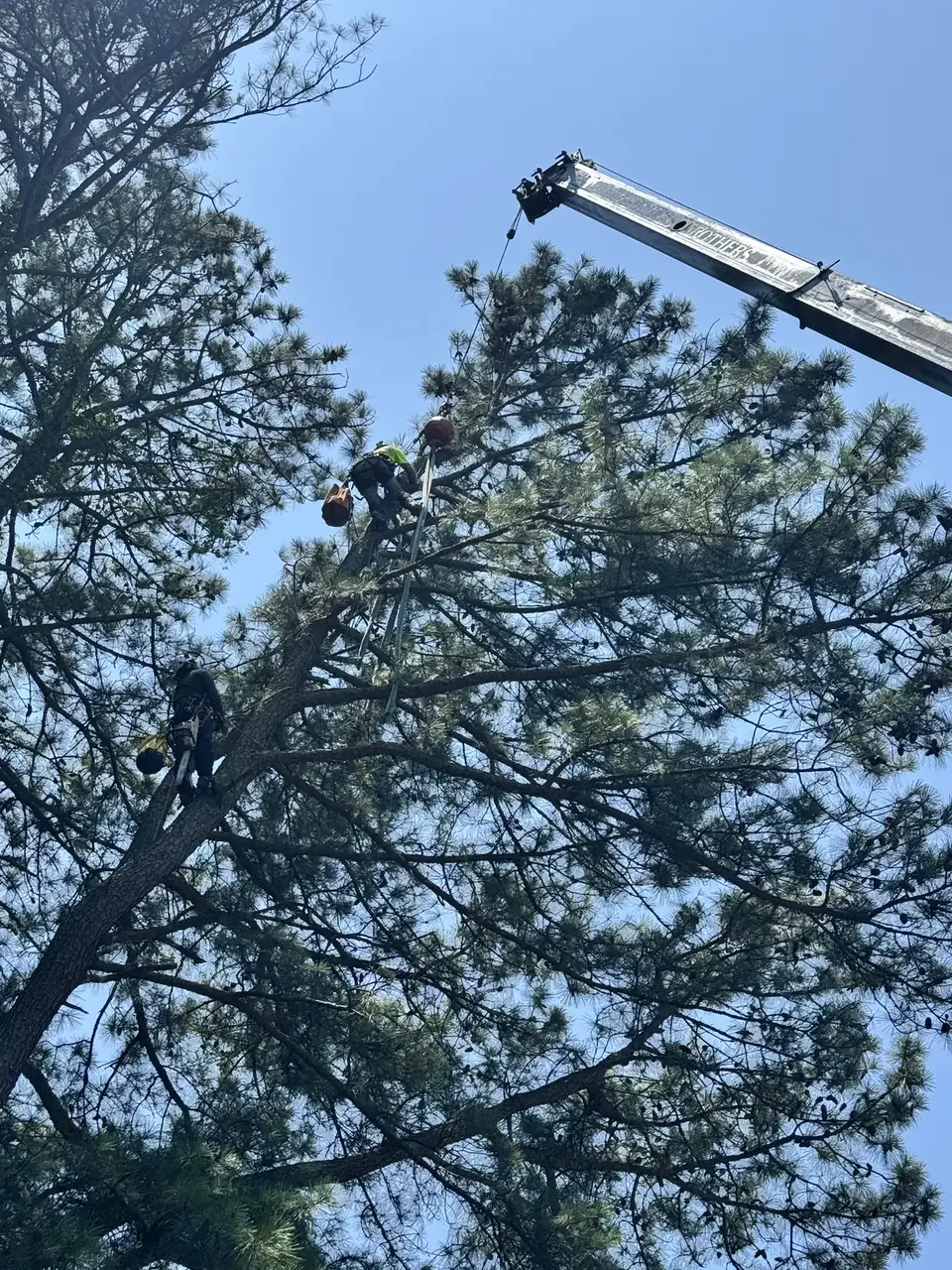
On that Chic’s Beach oak, a crane was the safe answer — the same call we make whenever a tree is too big or too committed to a target to bring down by hand, which I wrote about in our crane removal case study.
A crane changes the insurance question. You now have a machine setting up on the property, a boom swinging over the roof, and a load in the air. A policy written for lawn maintenance doesn’t contemplate any of that. Before a crane sets up on your property, it’s fair to ask whether the policy covers crane operations by name.
How to actually verify it, in about five minutes
Ask the agent, not the company
Request the certificate of insurance be sent directly from the insurance agent. A forwarded PDF proves less than it looks like it does.
Read the description of operations
It should say tree removal or arboricultural operations. If it says lawn care, landscaping, or grounds maintenance, the tree work is outside what was underwritten.
Look for a height restriction
If there is a height limit written into the policy, compare it to the actual tree. A 30-foot ceiling and a 70-foot pine are not compatible.
Confirm workers' compensation
General liability covers damage to your property. Workers’ compensation covers the person who gets hurt on it. On a rental property especially, you want both.
Ask about the crane by name
If crane work is part of the plan, ask whether crane operations are covered. The answer should be immediate.
None of this is adversarial, and any insured tree service in Virginia Beach doing this work properly will hand it over without being asked twice. It’s the same due diligence I walked through in how to choose a tree service.
Every employee signs a safety contract
Insurance is what happens after something goes wrong. The work happens before that, and it’s where the money is actually earned.
Virginia doesn’t leave tree work to industry goodwill. The Commonwealth enforces 16VAC25-73, Tree Trimming Operations, through the Virginia Department of Labor and Industry.1 It’s a regulation, not a suggestion, and it is built on the ANSI Z133 safety standard for arboricultural operations — covering electrical hazards, personal protective equipment, ropes and climbing equipment, rigging, tree removal, chipping, and required employee training.
Every person on my crew signs a safety contract built on that standard. It’s not a handbook that lives in a drawer. It names the work we do, the gear that’s mandatory for it, the approach distances we hold around energized conductors, and what happens if someone decides the rules don’t apply on a hot afternoon.
Z133 governs how nobody gets hurt. ANSI A300 is a separate standard governing how the cut itself is made — the difference between pruning a tree and wounding it, which is why we never put spikes in a tree we’re keeping. Both standards are in the contract, because both describe part of doing this properly.
I wrote about the safety side at length in our OSHA and ANSI Z133 case study, and about what happens when a storm turns those standards into the only thing between a crew and a serious injury in our storm damage case study.
We did that Chic’s Beach job. The pines came down, the oak came out over the roof on the crane, and the property went back to being a rental instead of a liability. That’s what a licensed and insured tree service in Virginia Beach is actually selling you.
The owner paid $2,240 more than he had to. What he actually bought for that money was the certainty that if something went wrong — a limb through the roof, a climber on the ground, a neighbor’s fence — it would be handled by a policy written for exactly that work, and not land on him.
That’s what the number on a tree bid is for. Ask both companies for the certificate. Read the description of operations. It takes five minutes and it’s the single most useful thing a property owner can do before anyone climbs anything.

Sources
1. Virginia Department of Labor and Industry — 16VAC25-73, Tree Trimming Operations, the Virginia occupational safety standard for arboricultural work, based on ANSI Z133.
2. Insurance Canopy — Tree Service Insurance Requirements & Coverage — the approximately 30-foot height ceiling on standard coverage, and exclusions for removals, stump grinding, and work within 15 feet of power lines.
3. Carolina Risk Partners — Why Tree Work Changes Your Coverage — standard landscaping policies excluding high-risk tree operations; arborists working 30 to 100 feet up on trees exceeding ten tons.
4. Workers Compensation Shop — Tree Service Class Code 0106 — the classification covering tree pruning, spraying, trimming, and removal, and its rating relative to landscaping.
5. International Society of Arboriculture — Hiring an Arborist — verifying proof of insurance before work begins.
Tree Service Insurance in Virginia Beach: FAQ
Find answers to common questions about our tree care services.
More questions? See our full tree service FAQ.