After the Storm
By Mike Campbell, Owner & Lead Climber, Art-is-Tree LLCPublished
- The region
- Hampton Roads — hurricanes, nor’easters, and the odd tornado
- When we’re busiest
- The 48 hours after a named storm
- What to watch
- Lean, root heave, cracks, decay, and hanging limbs
- The real danger
- Stored energy — storm wood is under load and unpredictable
- Featured here
- A root-failed tree rigged by hand + Broad Bay Island tornado pines
- Our response
- Licensed, insured, and ready for storm emergencies
Storms are when the phone doesn’t stop
If you live in Hampton Roads, you already know the routine. Every summer and fall we watch the tropics, and every few years something real comes up the coast — a hurricane, the tail of one, a nor’easter that parks off the coast for three days, or a fast, nasty line of storms that drops a tornado nobody saw coming. We sit on a flat, wet, low-lying coast that the National Weather Service office in Wakefield covers for exactly these events, and our soil holds water, which is a big part of why our trees come down the way they do.4
When the wind quits, my phone starts. And the work that comes after a storm is not the same job as a planned removal on a calm Tuesday. A storm-damaged tree is already broken, already loaded, already leaning on something it shouldn’t be — and everything about taking it apart safely changes because of that. This is an honest look at what we look for before a storm, what makes the cleanup so dangerous, and two real jobs that show what it actually takes.
The warning signs a tree is going to fail
Most trees that fail in a storm were telling you something first. The International Society of Arboriculture publishes a straightforward list of the things that make a tree hazardous, and after seventeen years of climbing them I look for the same handful every time I walk a property. That walk is a tree risk assessment, and it comes free with the estimate.1
- A new or worsening lean — especially one that started after the last storm, and most of all a lean with cracked or heaving soil on the high side of the root plate.
- Soil lifting or cracking around the base — that mounding or a gap opening on one side means the roots are already tearing — the tree is partway out of the ground.
- Mushrooms or conks at the base — fungal fruiting bodies on the root flare or lower trunk are a sign the roots or butt are rotting from the inside.
- Cracks, cavities, and included bark — vertical cracks, open hollows, and tight V-shaped unions where two stems press together are the places a tree splits apart.
- Deadwood and hanging limbs — dead branches and “widow-makers” already hung up in the canopy come down first and come down hard.
- A thin, dying, or one-sided canopy — sparse leaves or dieback up top usually means trouble down in the roots or trunk.
None of these guarantee a tree will fall, and none of them are a reason to panic and cut down every tree in the yard — trees are worth real money and real shade. But together they’re how a professional decides what needs attention before a storm turns a warning sign into an emergency.
A safety plan for your trees, before the season starts
The cheapest storm damage is the kind that never happens. The Virginia Department of Forestry and every arborist worth hiring say the same thing: the time to deal with a risky tree is on a calm day, not during a warning.3 Here’s the plan I’d give my own family.
Get the high-risk trees looked at
Have anything big near the house, the driveway, or a power line assessed before hurricane season. One honest inspection tells you what to watch and what to act on.
Prune out the deadwood and hangers
Removing dead limbs and structural weak points ahead of time takes away the first thing the wind throws at your roof.
Cable or brace where it makes sense
A tight, splitting union on a tree worth keeping can sometimes be supported with a cable or brace rod instead of removed.
Remove the ones that are already failing
A tree with root rot, a heaving base, or a serious lean over a target isn’t a pruning job — it’s a removal, and it’s cheaper standing than it is on your house.
And keep the boring habits: know where your gutters and drains are, don’t stack firewood or debris against the house, and after any big blow, walk the yard and look up before the kids and the dog go back out. If something’s hung up or leaning, keep everyone clear and call — do not walk under it.
The tree that came loose from its own roots
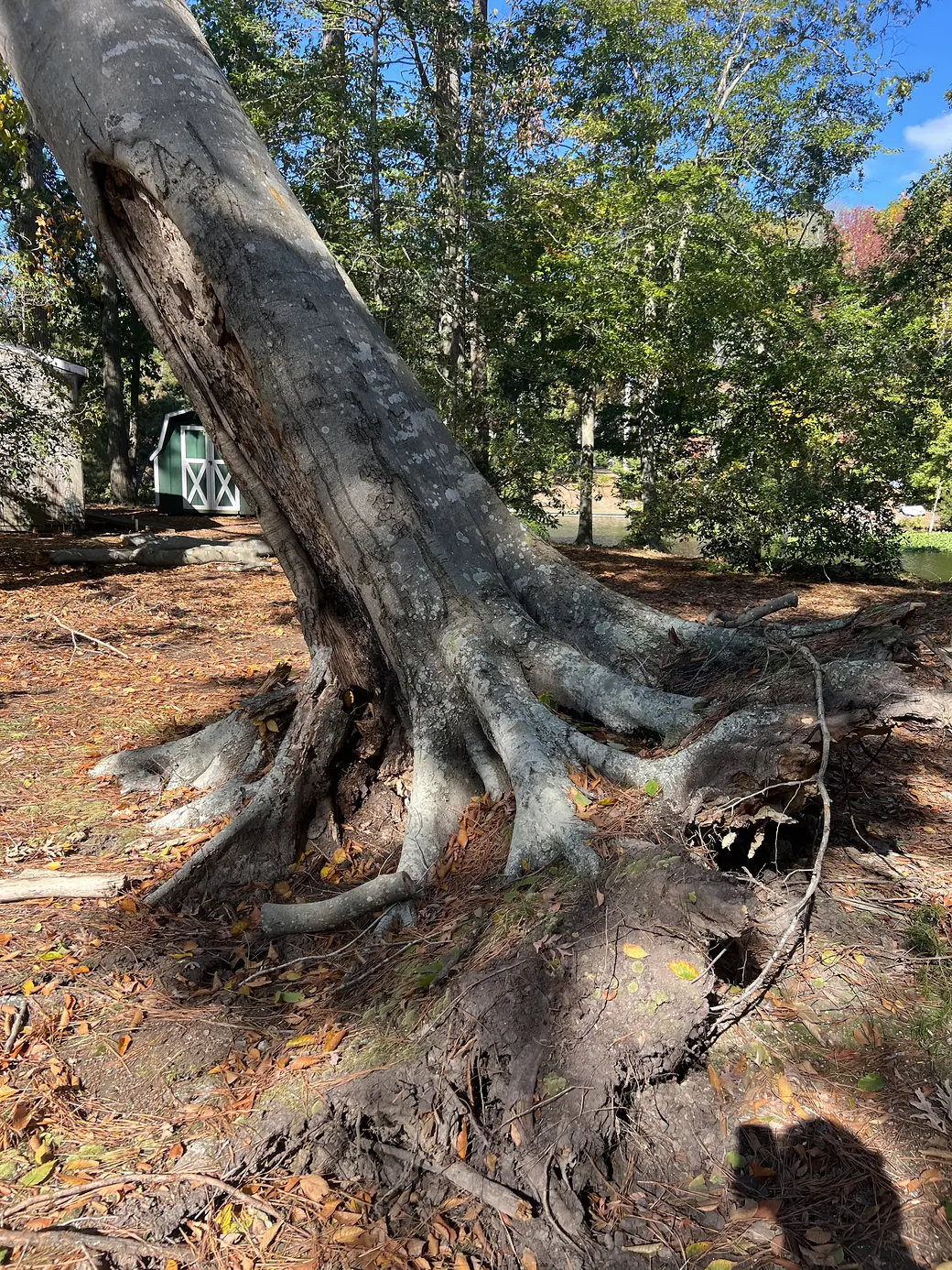
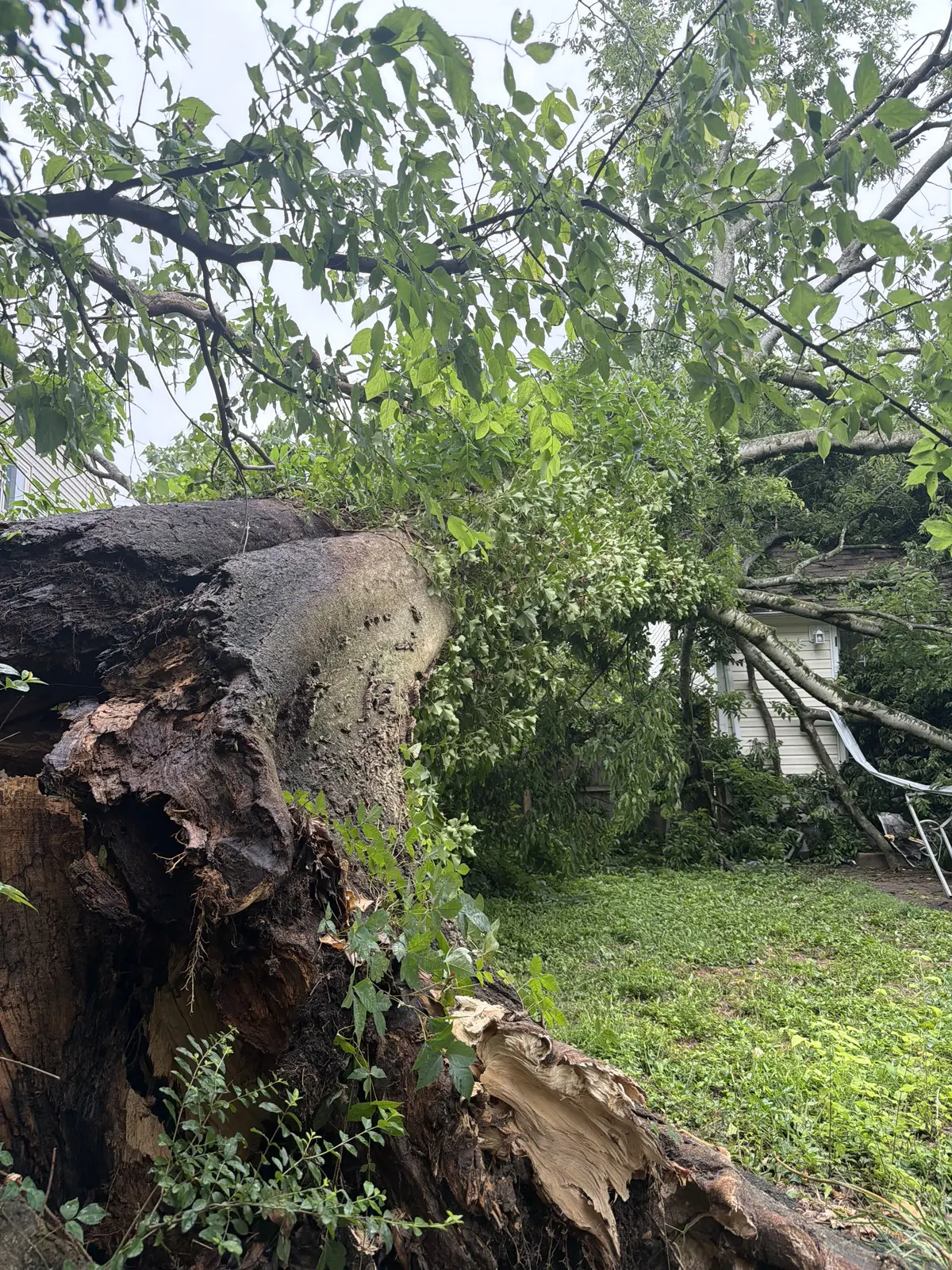
This one, on a waterfront lot here in Virginia Beach, was as close to a trap as trees get. It was a big beech, and the roots underneath it had rotted out and let go almost completely. The tree wasn’t just leaning — it was disconnected, sitting in a socket of soft ground, and every time we touched it the whole thing wanted to slide backward into the hole its own root plate had lifted out of. A tree that can move under you is a tree that can kill you.
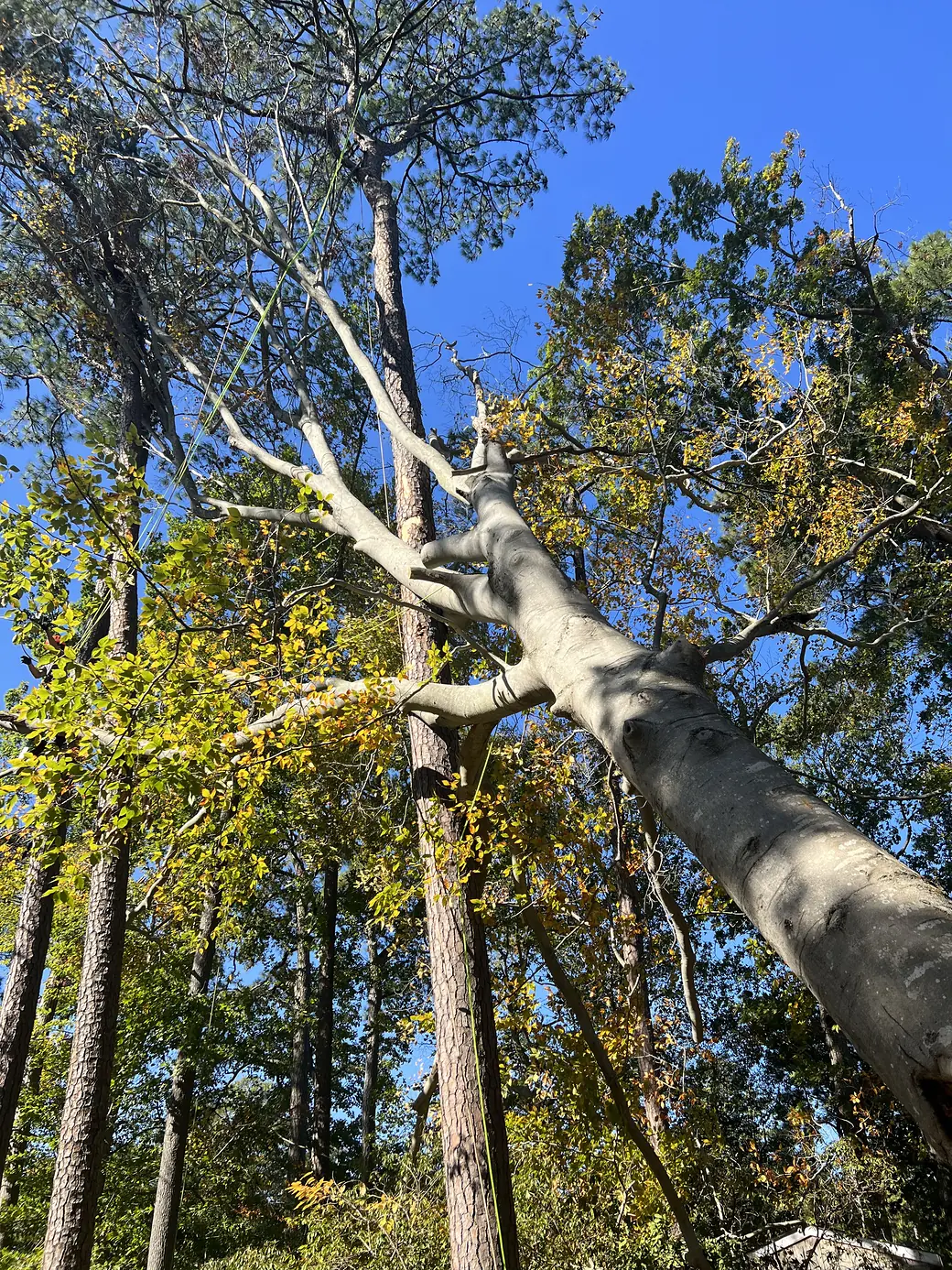
There was no crane answer here, either. The tree was tucked where a crane simply could not reach it — no setup, no angle, no way to get steel over it. So we built our own.
First we stopped the sliding. We set large pieces of dunnage — heavy timber blocking — down into the root hole to build a solid base, so the trunk had something firm to bear against instead of sliding farther back every time the load shifted. With the tree stabilized, we rigged our own lifting system: a series of span rigging lines strung between solid anchor trees, working like a highline — our own crane made out of rope and pulleys — so we could pick each piece, take its weight, and move it out over the ground that a machine could never have reached.
From there it was patience. Through bracing and multiple rigging points, we kept the trunk stable and secured at every stage while we dissected it piece by piece — each cut planned so the tree never got a chance to run. Nobody worked under an unsupported load, nothing came down until it was tied off and controlled, and the beech came apart in pieces instead of all at once.
- The tree
- A large waterfront beech, roots rotted and disconnected
- The hazard
- Unstable — the whole tree slid backward when loaded
- Access
- Zero crane access — no angle a machine could reach
- The base
- Heavy dunnage cribbed into the root hole to stop the slide
- Our “crane”
- Span (highline) rigging — rope and pulleys between anchor trees
- The method
- Bracing + multiple rigging points, dissected under control
Storm wood is loaded — and it doesn’t warn you
Here’s the thing most people don’t understand about a downed or broken tree, and it’s the thing that gets homeowners hurt every hurricane season. A storm-damaged tree is full of stored energy. A trunk bent over and pinned has tons of force wound up in it. A limb trapped under another is a loaded spring. A leaning tree half out of the ground is a counterweight waiting to swing. OSHA specifically warns that this stored energy — spring poles, bent limbs, trees under tension — is one of the deadliest parts of storm cleanup, because the moment you make the wrong cut, all that force releases at once, in a direction you didn’t predict.2
That’s why a storm job is really several dangerous jobs stacked on top of each other. Before any saw runs, we read the load in every piece: what’s in tension, what’s in compression, what’s holding what up, and what moves if we cut here versus there. We relieve that stored energy in a planned order, we rig pieces that would otherwise drop or swing, and we keep people out from under anything that isn’t controlled — the exact same discipline we bring to every job, which I wrote about in our safety and OSHA case study. When a piece is too big or too committed to a target to handle by hand, that’s when the crane earns its keep — and when a crane can’t reach, we build the rigging to do it by hand, like we did on the beech above.
A chainsaw and a good intention are exactly how people lose fingers, hands, and lives after a storm. There is no part of “a tree is on my house” that a homeowner should be solving alone.
The Broad Bay Island tornado
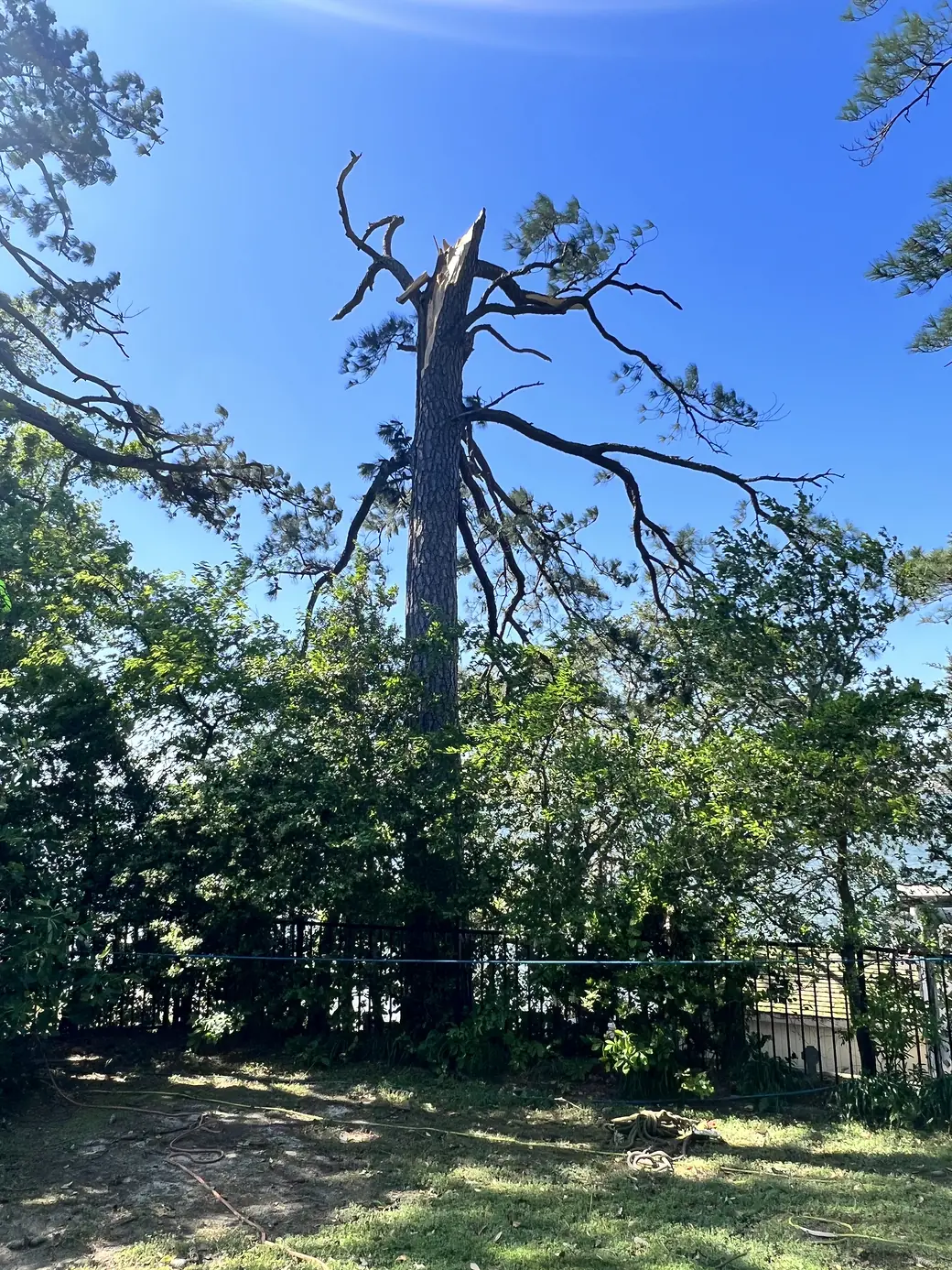
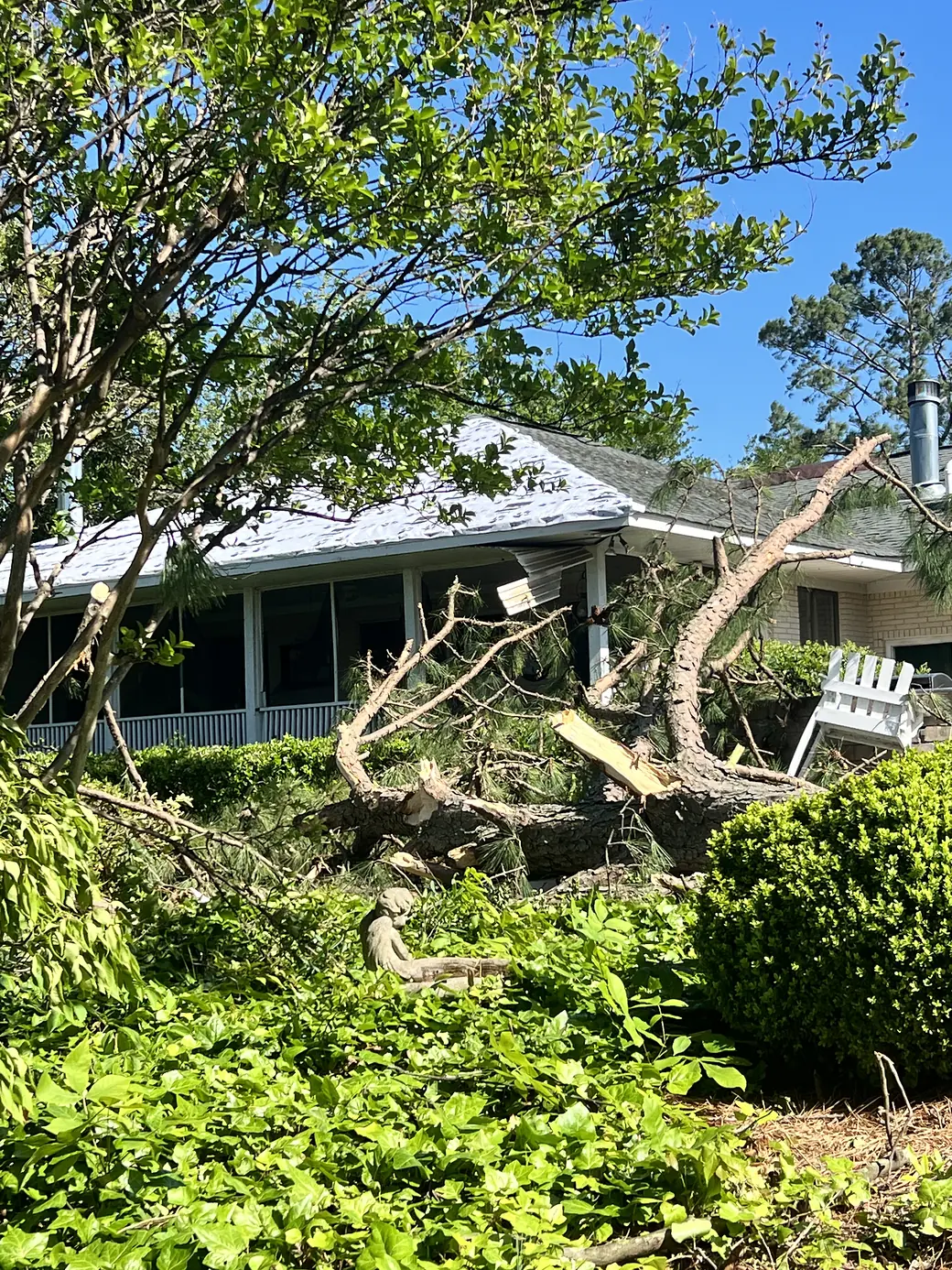
When a tornado tore through the Broad Bay Island neighborhood here in Virginia Beach, it did the kind of damage that reminds you wind is not gentle. This wasn’t trees tipping over. Mature pines were snapped clean in half, mid-trunk, and the tops were thrown — one of them a good hundred yards — toward the house.
A snapped pine is a different animal from an uprooted one. The break leaves a jagged, splintered spar still standing, often with the broken top hung up in what’s left or draped across a roof, and every piece of it is under load from the way it fell. On this property it wasn’t one failure, it was several at once — snapped trunks, a top against the house, debris flung across the whole lot.
So we worked it the way you have to work a storm: one hazard at a time, in order. We took the weight off the house first, relieved the tension in the pieces that were loaded, and rigged down the broken spars in controlled sections instead of trusting a splintered trunk to behave. What looks like a pile of firewood to walk up and cut is, up close, a yard full of springs — and clearing it safely is slow, deliberate, planned work.
A storm rarely takes just the tree — more often than not it takes a fence with it. Once we’ve cleared the tree and made the yard safe, we’ll point you to VB Fences for the fence repair that comes next — a local Hampton Roads crew we trust to rebuild what the storm knocked down.
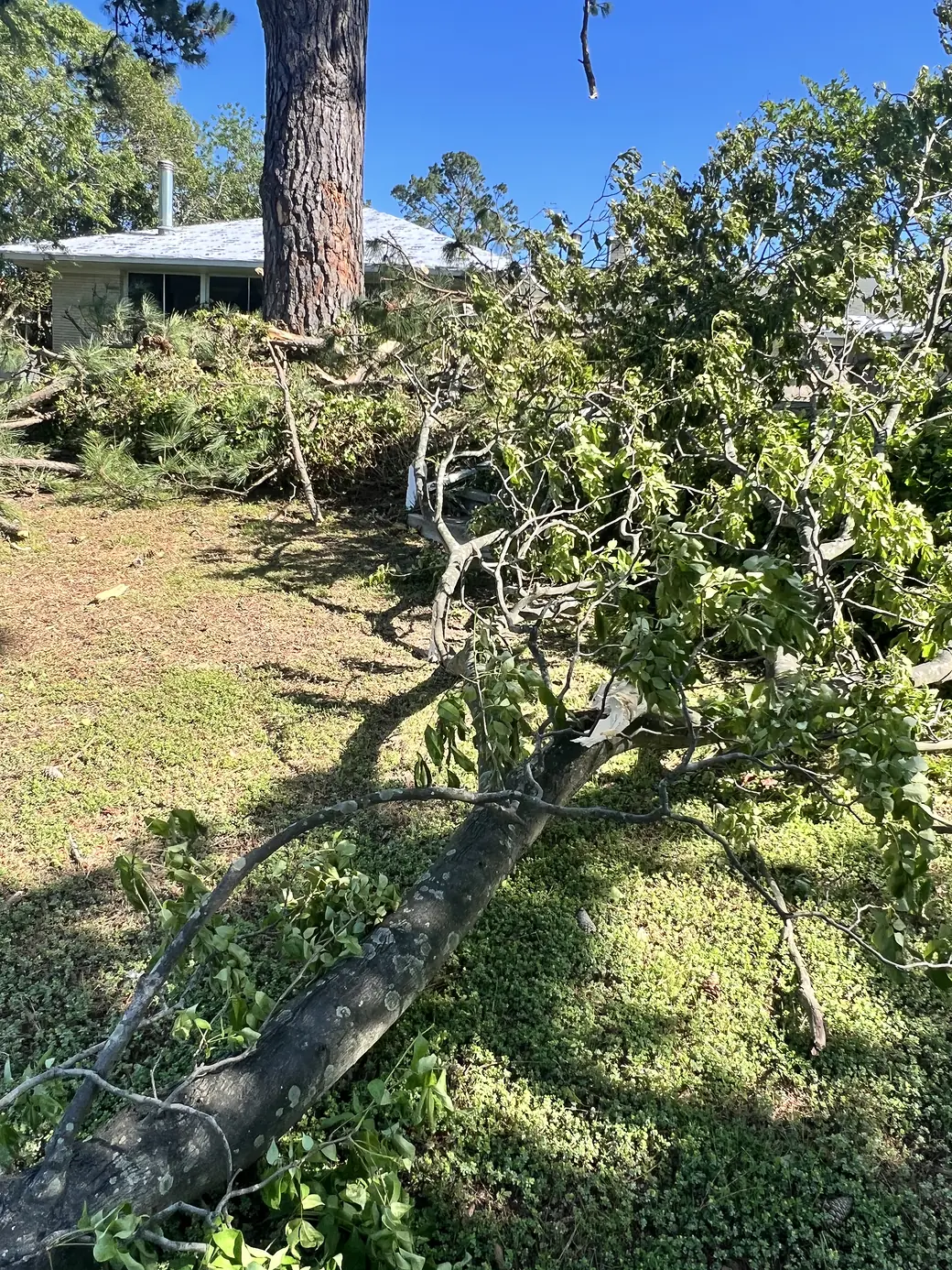
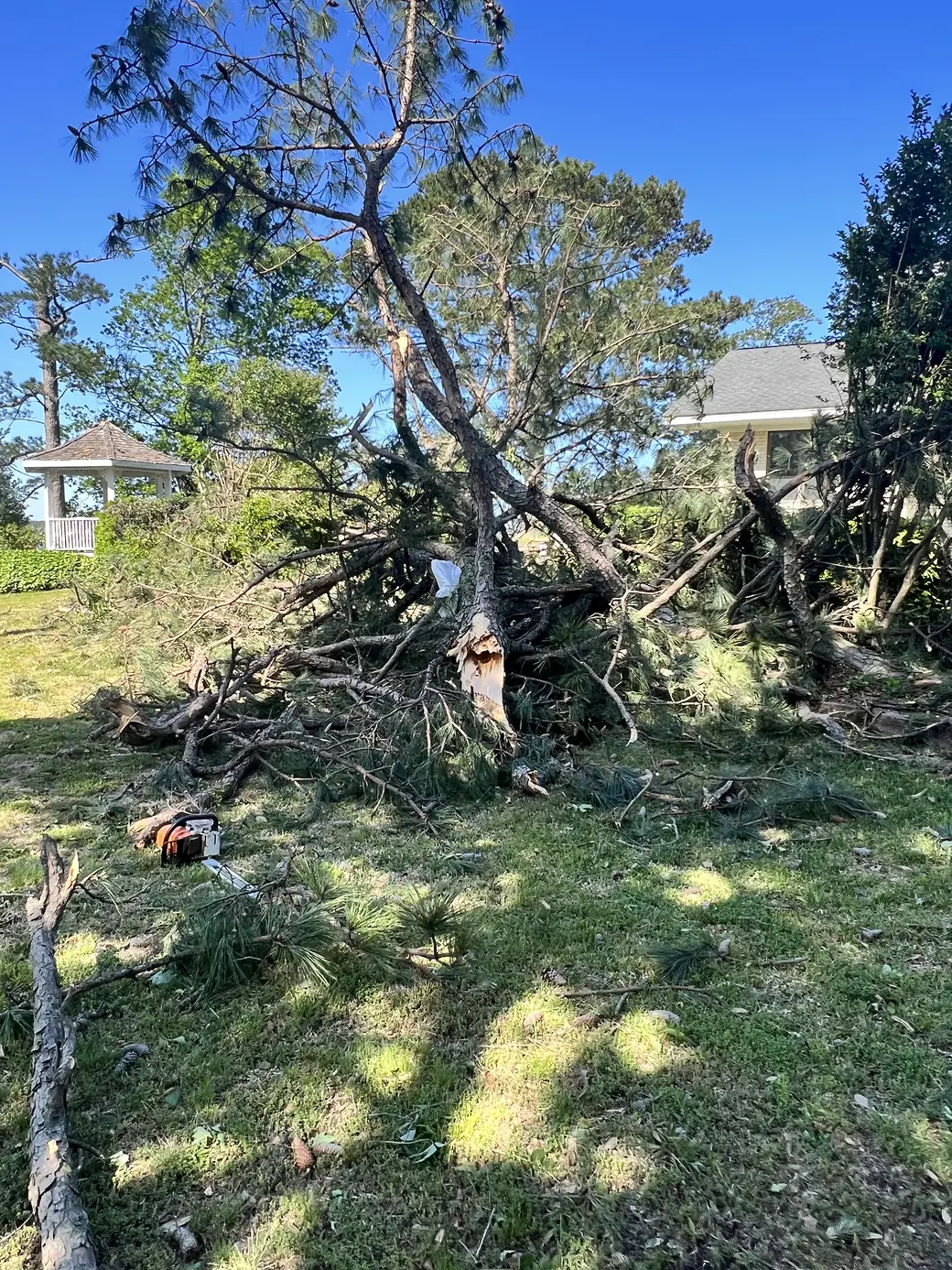
What storm failure actually looks like
Every storm call is different, but the failures rhyme: root plates levered out of saturated ground like the beech above, trunks snapped low at the base or mid-stem, and whole trees brought down across the yard or left resting against the house. Here are a few more from a storm-damage job in the Kempsville area of Virginia Beach.
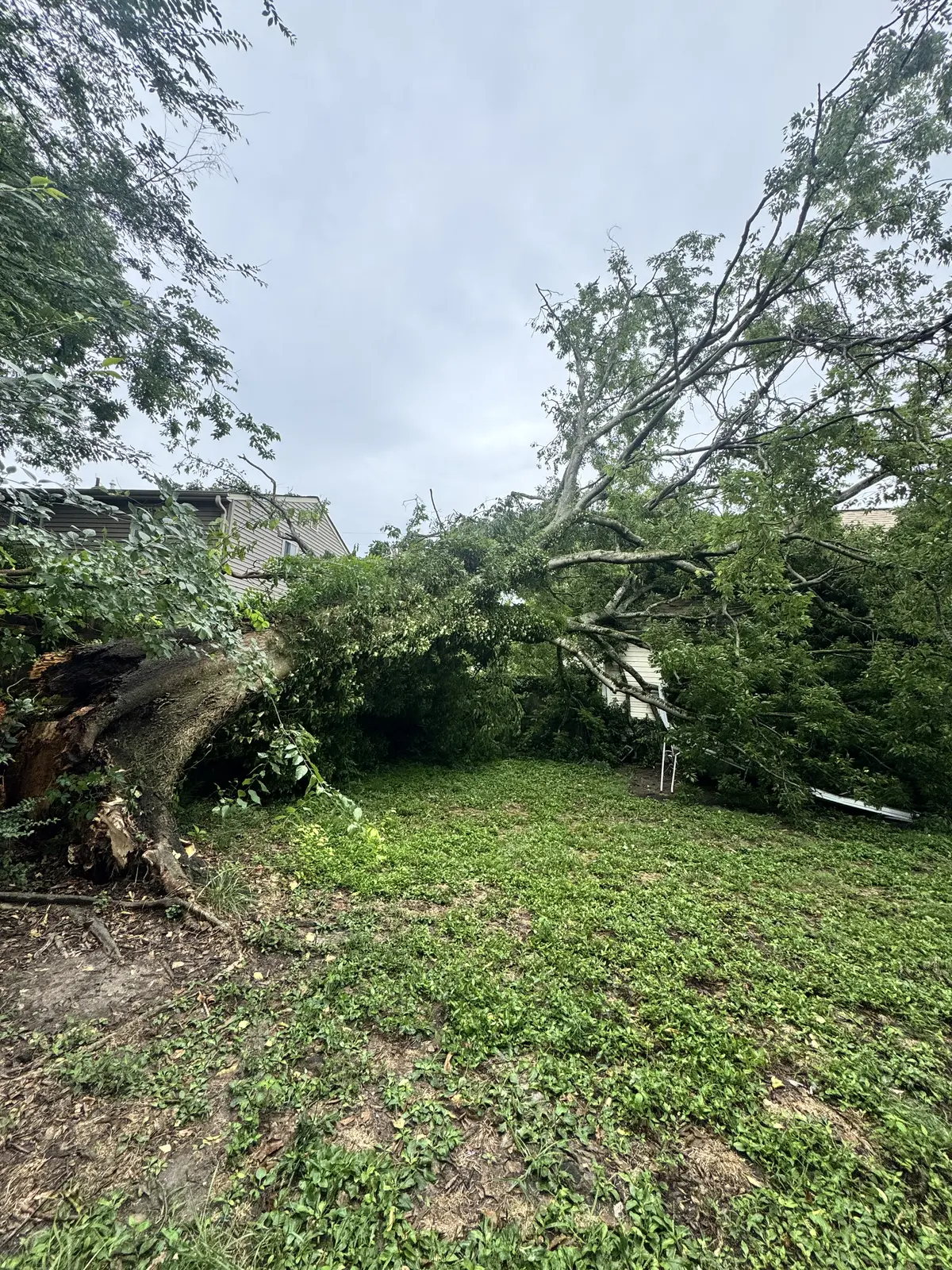
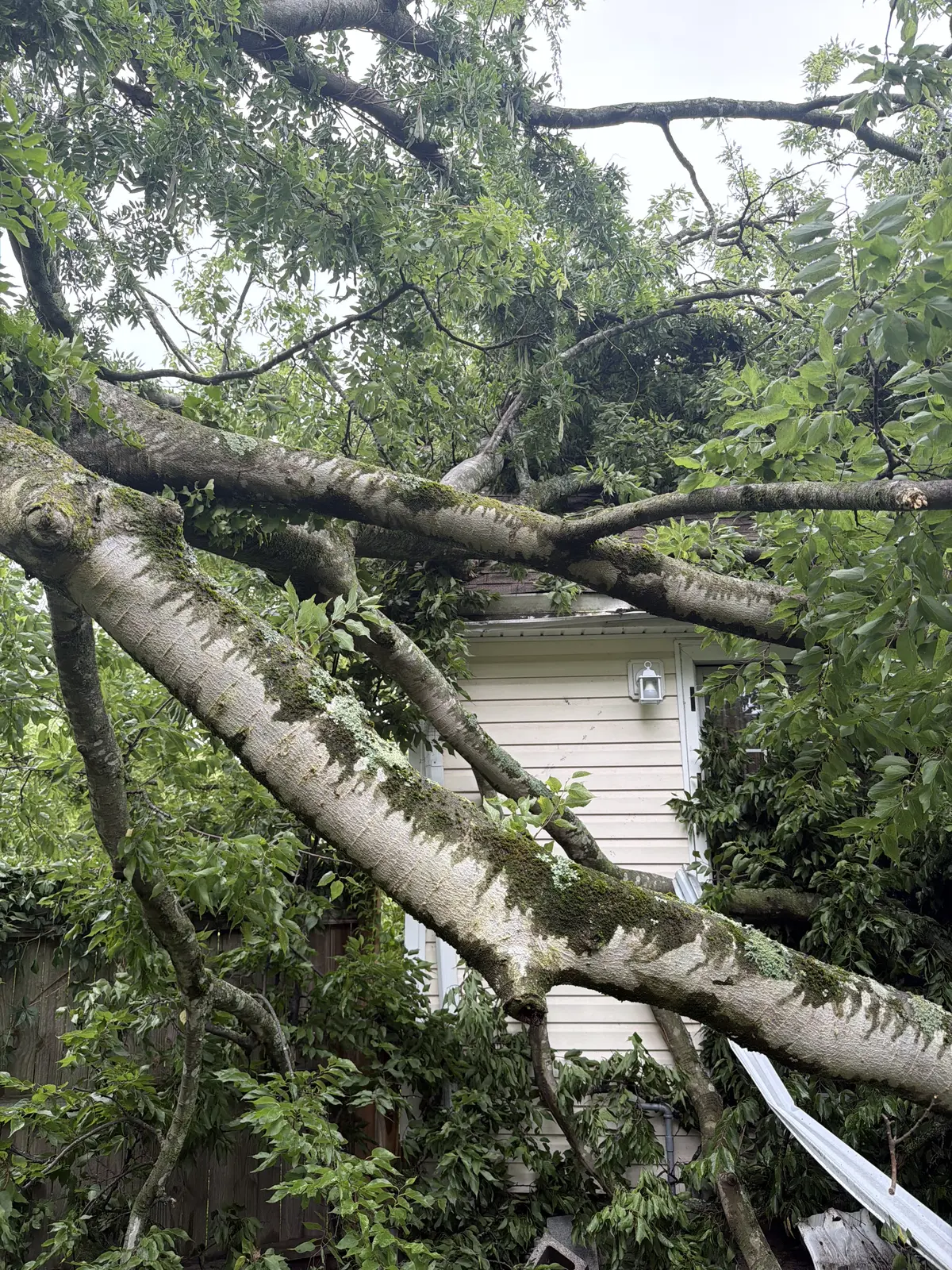
Licensed & insured
Real liability and workers’ comp coverage — so a storm job on your property never becomes your liability.
Load-aware rigging
We read stored energy and rig loaded wood down under control, by crane or by hand when a crane can’t reach.
Whole-yard cleanup
From the tree on the house to the last branch on the lawn — we leave it safe and clean, not half-done.
Storm-damaged, leaning, or on your house — we’ll handle it.
We cover storm and hurricane tree damage across Virginia Beach, Norfolk, Chesapeake and Portsmouth in Hampton Roads — licensed, insured, and set up to rig the trees other crews won’t touch. If it’s an active emergency, call us. If it’s a tree you want checked before the next storm, the estimate is free.
Sources
1. International Society of Arboriculture, TreesAreGood — Recognizing Tree Risk and Storm-Damaged Trees.
2. U.S. Occupational Safety and Health Administration (OSHA), Tree Care and tree/storm cleanup hazards — stored energy, spring poles, and loads under tension.
3. Virginia Department of Forestry — tree care and storm preparation guidance.
4. NOAA / National Weather Service, Wakefield VA (AKQ) — severe weather for Hampton Roads (tropical systems and tornadoes).