Why We Never Spike a Tree We’re Keeping
By Mike Campbell, Owner & Lead Climber, Art-is-Tree LLCPublished
- The practice
- Spikeless (rope-and-saddle) climbing on all pruning
- The tool we don’t use
- Climbing spikes / gaffs — removals only
- Why it matters
- Every spike wound is a doorway for decay and pests
- The standard
- ANSI A300 — the national pruning standard
- What it costs
- More skill and more time on our end, not yours
- What you get
- A pruned tree that stays healthy for decades
How you get up the tree matters as much as the cuts you make
There’s a part of tree work most homeowners never think to ask about, and it’s one of the most important things a company can tell you: how the climber gets up into the tree in the first place. Because there are two ways to do it, and on a tree you’re keeping, only one of them is right. We climb spikeless on every pruning job, and I want to explain exactly why, because it’s a genuine dividing line between careful tree care and the kind that quietly hurts your trees.
This isn’t a story about one dramatic removal. It’s about a decision we make on every single pruning job, on ornamentals and shade trees all over Virginia Beach — a decision that doesn’t show up in the after photo but shows up years later in whether your tree is thriving or slowly rotting from a hundred small wounds.
I’ve been climbing trees around Hampton Roads for years, and I’ll be honest: spiking is faster, and there were plenty of jobs early on where it would have been the easy call. But once you understand what those spikes do to a living tree, you can’t un-know it. Doing it the right way became non-negotiable for us, and it’s one of the clearest ways to tell a real tree-care company apart from someone just clearing branches for cash.
Spikes versus rope and saddle
The old, fast way is climbing spikes — also called gaffs or spurs. They’re steel spikes that strap to the climber’s boots, and the climber literally kicks them into the trunk to walk up the tree. They’re quick, they’re easy, and for a tree that’s coming down anyway, they’re completely fine — that’s what they’re made for.
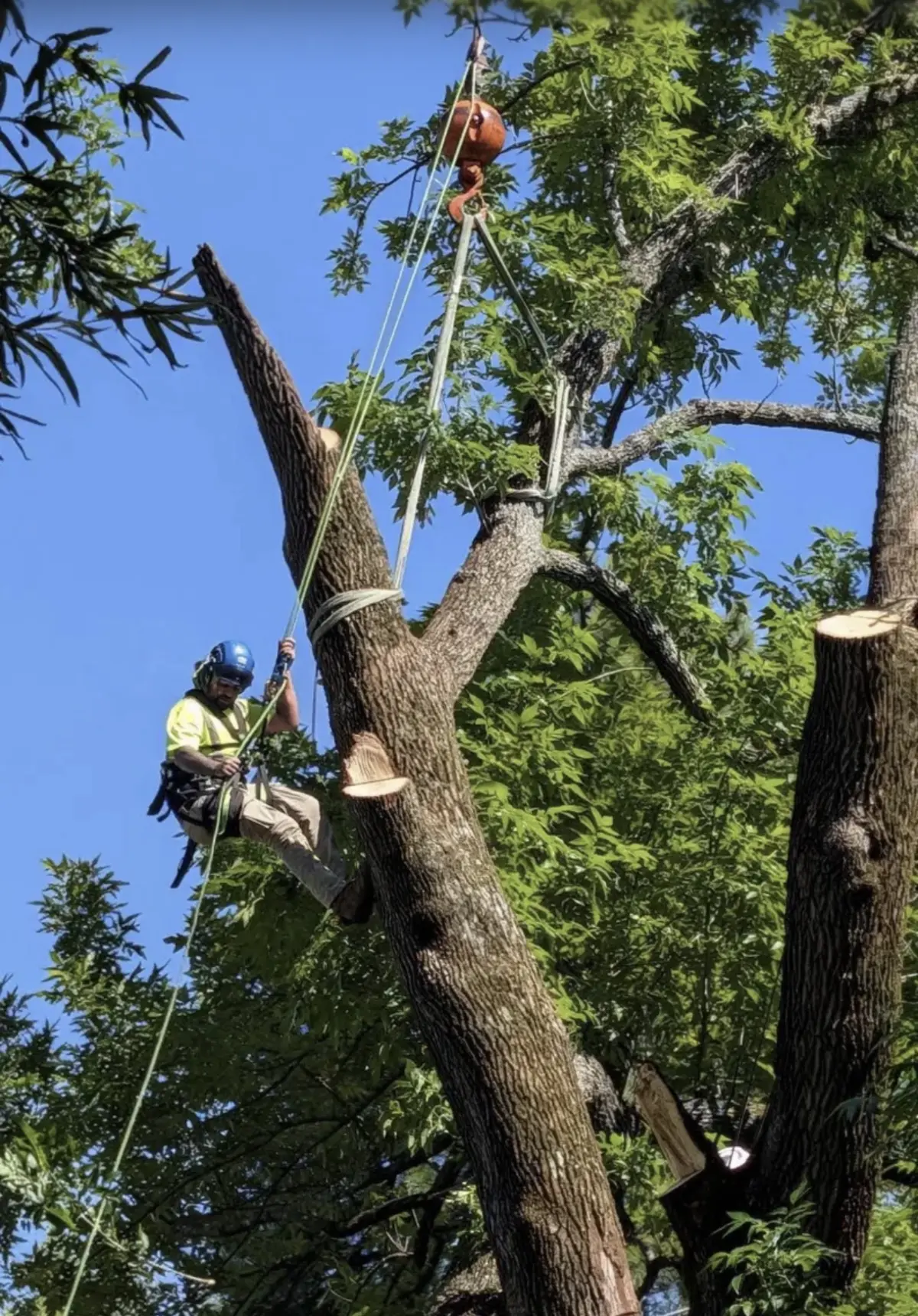
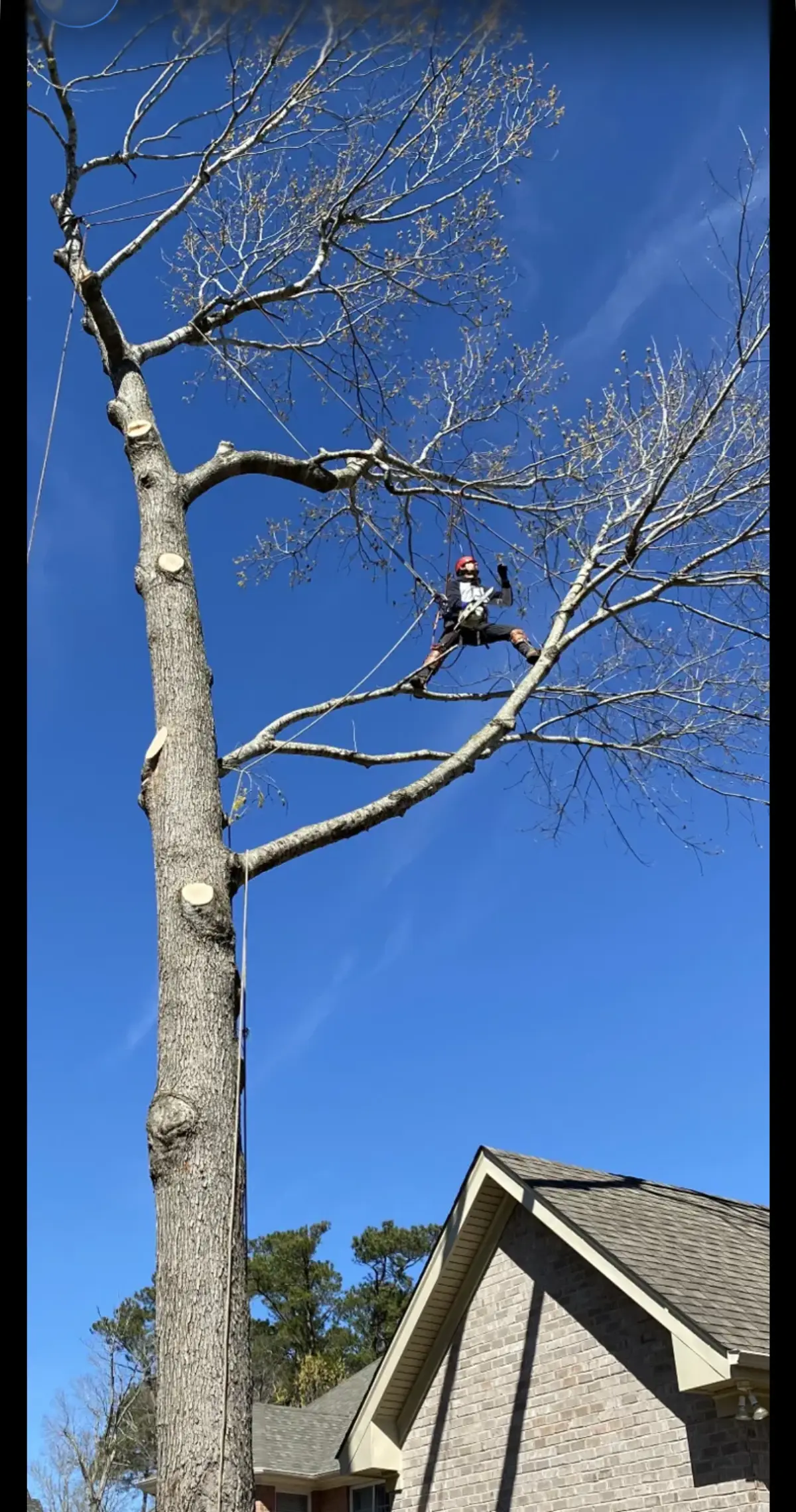
The right way on a tree you’re keeping is spikeless climbing: the climber ascends on a rope and saddle, using friction hitches and mechanical devices to move through the canopy, or works from a bucket truck where the tree allows it. Nothing ever gets kicked into the trunk. It takes more skill, it takes more time, and it takes real training to do well — which is exactly why some outfits skip it.
Here’s the rule we live by, and it’s the industry’s rule too: spikes are for removals, never for pruning. The moment a tree is staying in the ground, the spikes come off the boots.
Every spike is a wound that never fully heals
People assume a spike just leaves a little hole in the bark. It’s worse than that. A tree’s living tissue — the cambium, the paper-thin growing layer just under the bark that builds the new wood and inner bark that carry water and nutrients — is right where the spike goes in. Each spike punches through the bark and gouges that living layer. On the way up a big tree, a climber on spikes leaves dozens of these wounds, staggered up the whole trunk.
And trees don’t heal like we do. They can’t replace damaged tissue — they can only wall it off, sealing the wound to try to keep decay from spreading.1 Every one of those spike holes is an open door before it seals, and it’s exactly the kind of fresh wound that decay fungi, bacteria, and boring insects look for. You take a perfectly healthy tree, prune it “nicely,” and hand it a trunk full of infection sites on the way up. Over years, repeated spiking is a real drain on a tree’s health and can shorten its life.
What the national pruning standard requires
Tree pruning in this country is governed by a written standard called ANSI A300 — the American National Standard for tree pruning — and the best management practices published by the International Society of Arboriculture that go with it.2 These aren’t suggestions I made up; they’re the consensus rules the whole industry is measured against.
Those standards are clear that climbing spikes should not be used to climb a tree that’s being pruned — they’re reserved for removals, aerial rescue, or the rare case where there’s truly no other safe way. The same standards define how the cuts themselves should be made: clean cuts at the branch collar, no flush cuts, no topping, and generally no more than about a quarter of the live crown removed at one time.1
When we tell you we prune to ANSI A300, spikeless climbing is part of that promise. It’s the difference between someone following the actual standard of care and someone just cutting branches.
Why spikeless is worth the extra effort
All of the extra skill and time goes into one thing: handing your tree back healthier than the shortcut ever could. Here’s what that buys you.
No new wounds
Nothing gets kicked into the trunk, so the bark and the living layer under it stay intact and protective.
Far lower disease risk
No fresh spike holes means no easy entry points for decay fungi, bacteria, and boring insects.
Less stress on the tree
The tree spends its energy growing, not sealing off dozens of avoidable injuries.
A longer, healthier life
Protecting the trunk protects the structural integrity and lifespan of a tree you want to keep for decades.
This matters even more in our climate. Hampton Roads is warm, humid, and wet a good part of the year — ideal conditions for the decay fungi that move into fresh wounds. A trunk full of spike holes in coastal Virginia isn’t a minor cosmetic issue; it’s an open invitation in the exact environment where rot spreads fastest. The trees we grow the most of here, from loblolly pines to live oaks and crepe myrtles, all do better when the trunk is left intact and the only cuts on the tree are the deliberate, clean pruning cuts up in the canopy.
There’s a curb-appeal angle too. A tree pruned correctly and climbed spikelessly simply looks better and stays looking better — no rows of oozing wounds up the trunk, no dieback where infection took hold. If you ever sell, that healthy, well-kept tree is part of what makes the property show well, which is a whole story on its own in our property value case study.
What Virginia Beach homeowners should ask
Here’s the practical takeaway, and it’s an easy one. If you’re hiring anyone to prune — not remove, prune — a tree you intend to keep, ask them one question: “Are you going to climb it on spikes?” The right answer is no. If a company tells you they spike everything, or gets cagey about it, that tells you how much they actually care about the tree versus how fast they want to be done.
It’s also worth knowing the flip side: when a tree is coming down, spikes are exactly the right tool, and there’s nothing wrong with using them on a removal. The skill is knowing which job you’re on and matching the method to it — spikeless for anything you’re keeping, spikes only for what’s leaving. A company that understands that distinction, and can tell you which one your tree is, is a company that’s thinking about your tree’s future and not just today’s cut.
At Art-is-Tree we use rope-and-saddle climbing and bucket trucks for all of our trimming and pruning work, and we save the spikes for trees that are coming down. It’s slower, it’s harder, and it’s the right way to do it. If you’ve got a tree in Virginia Beach, Norfolk, Chesapeake or Portsmouth — anywhere in our Hampton Roads service area — that needs pruning, we’ll come take a look, tell you honestly what it needs, and we’ll never put a spike in a tree we’re leaving standing. The estimate is free.
Sources
1. International Society of Arboriculture, “Pruning Mature Trees” — proper cut placement, how trees compartmentalize wounds, and best climbing practices.
2. ANSI A300, Tree Care Operations — Pruning: the American National Standard for tree pruning.
Pruning done to standard — spikeless, every time.
We prune to ANSI A300 and climb spikeless on every tree we’re keeping, all across Virginia Beach and Hampton Roads. Let’s keep your trees healthy for the long run.
Schedule a Consultation