Crane-Assisted Removal of Storm-Damaged Pines
By Mike Campbell, Owner & Lead Climber, Art-is-Tree LLCPublished
- Location
- Waterfront lot, Virginia Beach
- The trees
- Several large, declining loblolly pines
- The problem
- Leaning toward the house — no safe fell path
- Access
- Tight lot bordering a protected shoreline
- Method
- Crane-assisted sectional removal
- Outcome
- House & shoreline protected, cleared in one visit
Some trees you don’t get to just drop
People see a crane roll up to a tree job and assume it’s overkill — a way to pad the bill. It’s usually the opposite. A crane is what we reach for when dropping a tree the normal way would mean gambling with a roof, a fence, the power lines, or a protected shoreline. On the right job it isn’t the expensive option; it’s the only safe one. This waterfront removal in Virginia Beach is a good example of why.
I’ve been climbing and running removals around Hampton Roads for years, and the crane jobs are the ones people remember — usually because the tree was the kind that scared them. Big, dead, leaning the wrong way, hanging over the one thing they care most about. Here’s how one of those goes when it’s done right, start to finish.
No safe direction to drop them
The lot was tight and right on the water. Several tall loblolly pines had declined to where they were leaning toward the house — years of coastal storms had opened cracks in the trunks and killed off whole sections of canopy. That’s the kind of damage that turns a tree into a liability the next time the wind really picks up, and these were well past saving.
The problem was that there was nowhere safe to put them. The house sat on one side. On the other was the water and its protected shoreline buffer, where heavy equipment and debris aren’t allowed. Mature landscaping filled the gaps in between. Felling these pines the old-fashioned way — cutting them at the base and dropping them — would have meant betting the roof, the fence, or the shoreline on where an 80-foot tree decided to land. I wasn’t willing to make that bet, and you shouldn’t let anyone make it with your property either.
Loblolly pines are the tallest thing in most Hampton Roads yards, and that height is exactly what makes a declining one so dangerous — a lot of weight, a long way up, standing in sandy coastal soil that loosens its grip on the roots every time the ground floods. A compromised pine like that doesn’t give much warning before it goes, and when it goes, it goes all at once.
Take it out from the top, one section at a time
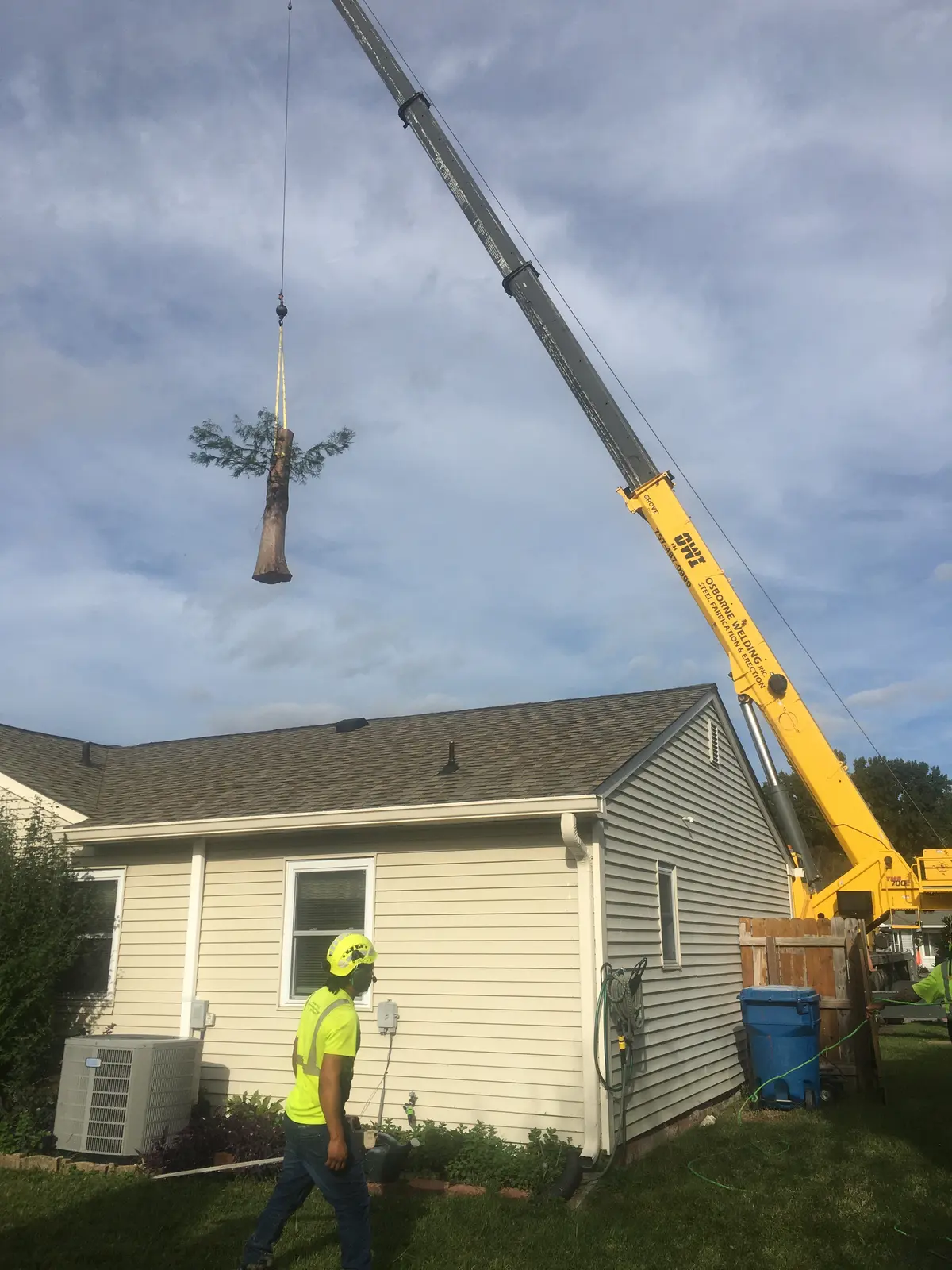
Instead of dropping the pines, we removed them with a crane. The crane sets up on the street side with its outriggers down, well clear of the shoreline. Then the work is methodical:
- Plan the picks. We map each cut before anything runs — where the crane sits, how much each section weighs, and the exact path it will travel.
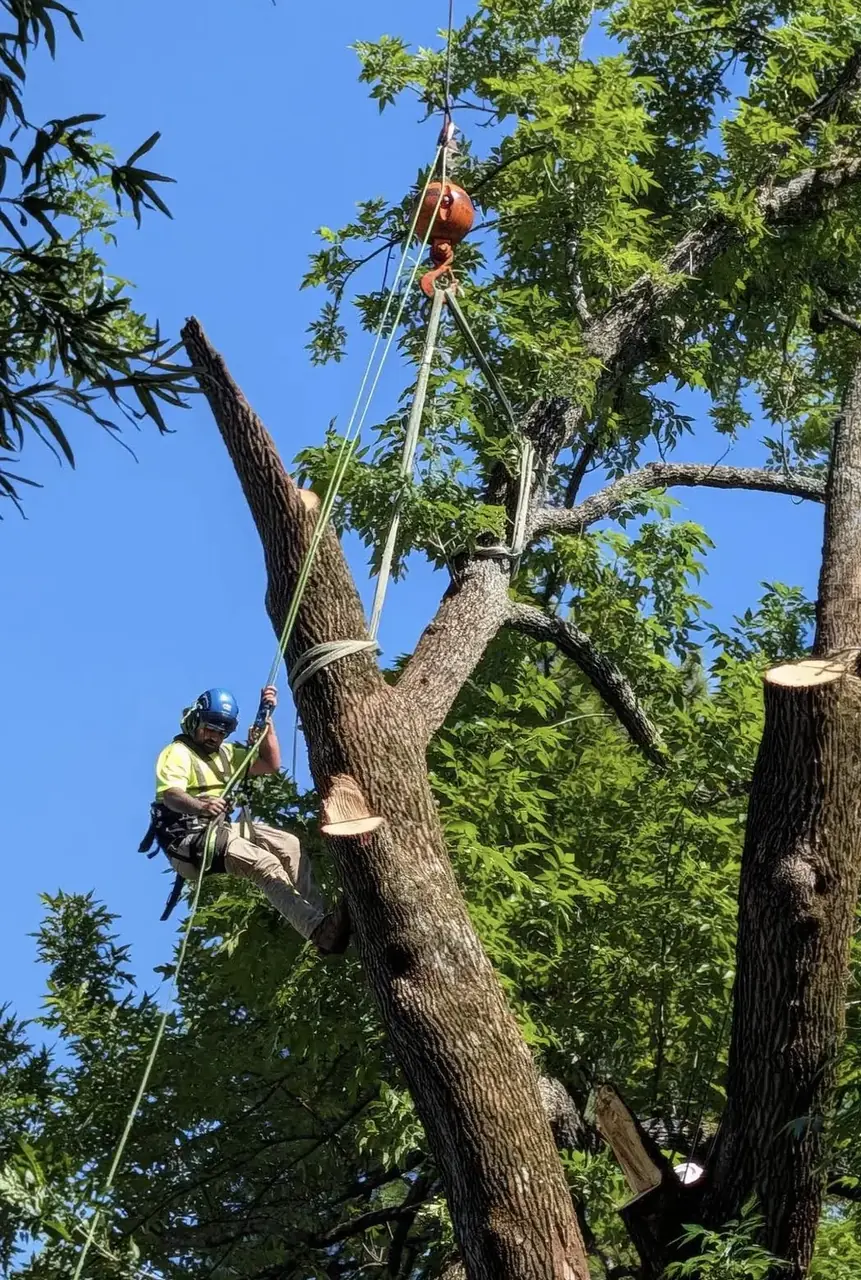
- Rig before the cut. A climber slings each section to the crane first. The crane takes the weight so there is no shock load and nothing drops.
- Lift up and over. Each section is lifted straight up and swung over the house to a clear drop zone — never dragged across the roof or landscaping.
- Process away from the water. The ground crew limbs and chips everything in the staging area, keeping all debris and machinery out of the shoreline buffer.
What makes it work is the coordination between the climber and the operator. The climber sets the sling exactly where the section will balance, calls the pick, and only makes the cut once the operator has taken the tension. Everybody on the ground stays out from under the load. From the street it looks slow and deliberate — and that’s the point. Slow and deliberate is what keeps two tons of pine from going anywhere it isn’t supposed to.
On a crane job, safety isn’t a preference — it’s a standard
There’s a national safety standard for exactly this kind of work — ANSI Z133, the American National Standard for Arboricultural Operations. It’s written by arborists for arborists, and it’s the benchmark a legitimate tree company holds itself to.1 A crane removal has hard rules under it: the operator stays at the controls the entire time a load is suspended, every section is rigged to keep it from shifting, and loads are lowered under control — no shock-loading, no free fall, ever.1
That last part is the whole point. When we make the cut, the section is already hanging on the crane — the wood never gets a chance to fall. We weigh our picks against the crane’s load chart so we’re never asking the machine to lift more than it safely can, and the climber and operator run on a fixed set of hand signals so there’s zero confusion sixty feet up. None of that shows up on the invoice, but it’s the entire difference between a controlled removal and an accident waiting to happen. When you hire a crew for a crane job, that discipline is what you’re actually paying for.
It’s also why insurance matters so much on this kind of work. A crane pick gone wrong doesn’t scratch a fender — it puts a two-ton log somewhere it shouldn’t be. We carry full liability and workers’ comp coverage precisely because the stakes are high, and that means if anything ever did go wrong, it’s our insurance that answers for it, not the homeowner’s. Before you let any crew put a crane over your house, ask them for proof of insurance. A legitimate outfit hands it over without blinking.
Keeping the shoreline buffer untouched
Waterfront lots in Virginia Beach often fall under the Chesapeake Bay Preservation Act, which restricts clearing and heavy equipment inside the shoreline buffer. Lifting the tree out by crane meant we never had to bring machinery near the water or drag debris through it.
So we set the crane up on the street side, dropped the outriggers well back from the bank, and flew every piece out over the house to a staging area on the driveway. Nothing ever touched the buffer. On a normal lot that’s just good practice; on a Chesapeake Bay Preservation Act lot, it’s the line between a clean job and a code violation with a per-day fine attached.
“A crane turns a gamble into a controlled lift. You decide exactly where every piece goes.”
When you actually need a crane — and when you don’t
I’ll be the first to tell you a lot of trees don’t need a crane. If there’s a safe direction to drop it and room to work, climbing and rigging it down by rope is faster and cheaper, and that’s exactly what we’ll quote you. I’m not going to roll a crane out to a backyard pine in the middle of an open lot just to make the job look bigger — that’s not how I do business.
Where a crane earns its keep is a job like this one: a big, heavy, compromised tree with no safe fell path and something valuable underneath it — a roof, a pool, power lines, a shoreline you’re not allowed to touch. A dead or storm-cracked tree is also unpredictable; the wood is brittle and doesn’t rig or hinge the way a healthy tree does. Taking the weight with a crane before we ever cut removes the guesswork. When I recommend a crane, it’s because the alternative is a gamble I wouldn’t take on my own house — and I’ll walk you through exactly why on your specific tree.
Setting up and taking the weight
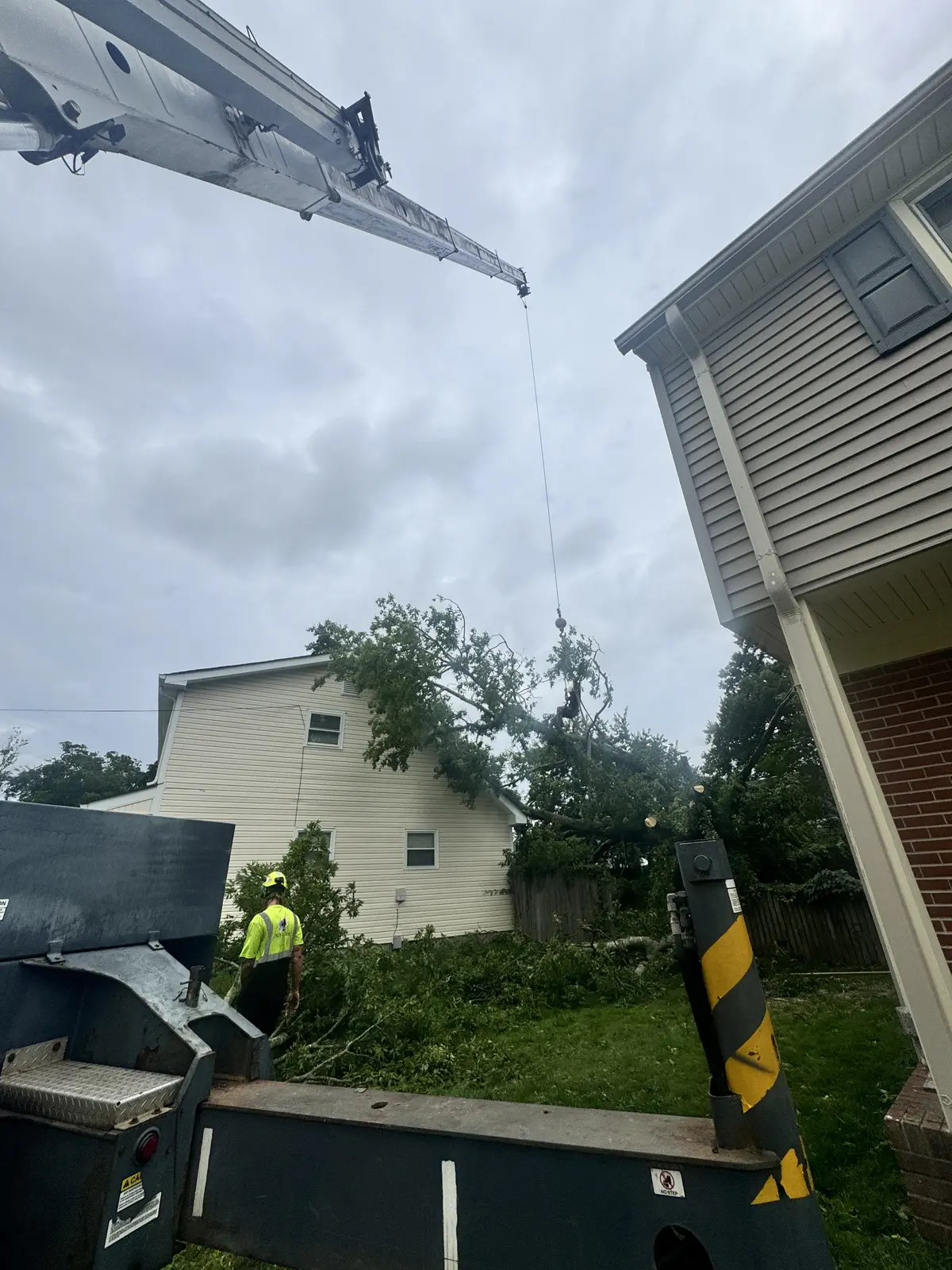
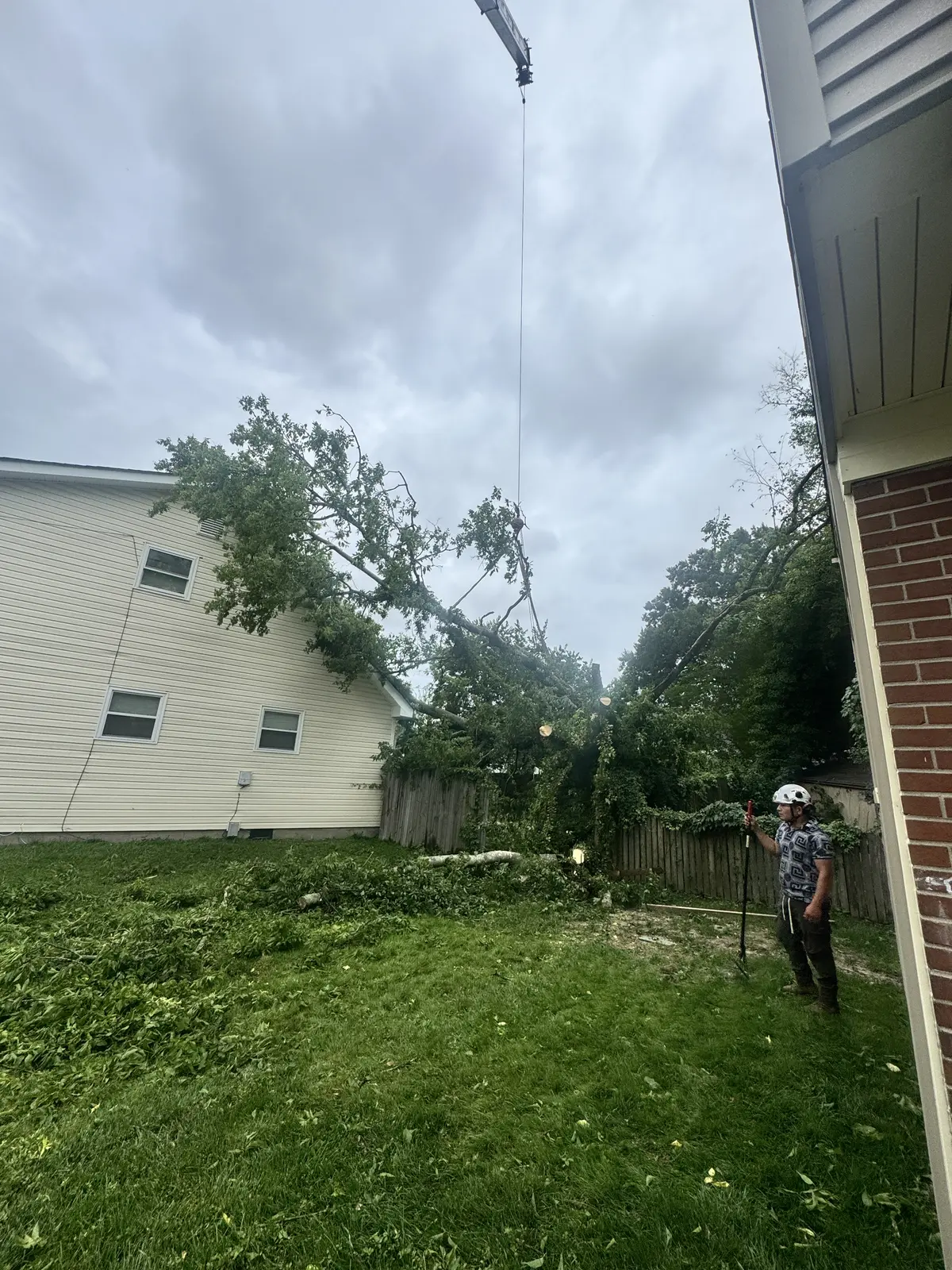
Here’s what a crane removal actually looks like on the ground in the Kempsville area of Virginia Beach — the truck set up with outriggers down and the boom over the house, and a groundman guiding each pick in as the crane takes the load off the tree before the cut.
A clean, controlled removal — in one visit
We took the whole stand of pines down in a single day. Every section came off the same way — rigged, lifted, flown out, processed — and by the time we pulled the crane off the street, you couldn’t tell we’d run a major removal on a waterfront lot. The client went from lying awake through every storm to never having to think about those trees again.
No damage
The roof, fence, and landscaping came through untouched.
Buffer protected
No equipment or debris ever entered the shoreline buffer.
Hazard gone
What could have failed in the next storm was removed safely.
Sources
1. ANSI Z133, American National Standard for Arboricultural Operations (ansi.org).
A big tree over the house doesn’t have to be a gamble.
If you’ve got a large or leaning tree near your home, fence, or the water, we’ll come look at it and tell you honestly whether it needs crane tree removal in Virginia Beach. The estimate is free.
Get a Free Estimate