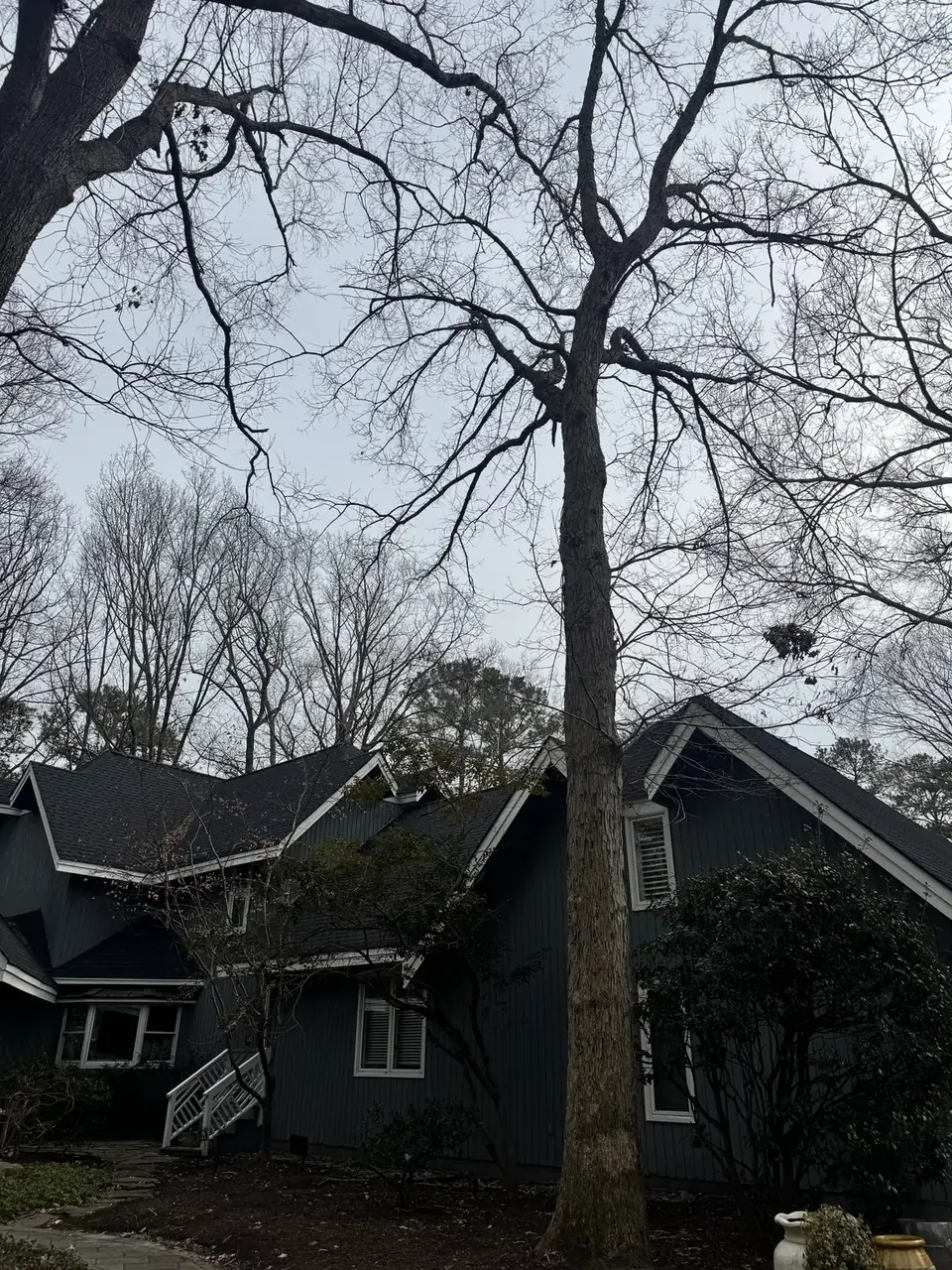
The Law Under the Grass at the Water’s Edge
By Mike Campbell, Owner & Lead Climber, Art-is-Tree LLCPublished
- Location
- Private waterfront property, Hampton Roads
- The rule
- Chesapeake Bay Preservation Act (RPA / RMA)
- The tree
- A family’s mature hardwood near the water’s edge
- The catch
- A 100-ft protected shoreline buffer with strict limits
- What we did
- RMA removals + RPA-compliant crown reduction
- Outcome
- Fully compliant, property and buffer both protected
The conversation nobody expects
Some of the toughest conversations I have in this business aren’t about the tree at all — they’re about the law sitting invisibly under someone’s waterfront yard. I’ll be standing in a backyard in Virginia Beach or Norfolk, a homeowner points at a tree by the water and says “take that one down,” and I have to be the one to tell them it isn’t that simple. Most people have never heard of the Chesapeake Bay Preservation Act. And I’ll be honest — there are tree companies out here who know that, and count on it.
I’d rather you hear it from me. This is a real waterfront job we did, what we found, how the rules actually work, and why we handled it the way we did — so you know what you’re dealing with before somebody talks you into a cut that lands you a fine.
What the Chesapeake Bay Preservation Act actually is
Virginia passed the Chesapeake Bay Preservation Act back in 1988 to protect water quality in the Bay — the largest estuary in the United States — by controlling how land near the water gets used.1 The part that matters for your trees is the Resource Protection Area, or RPA. That’s the tidal wetlands, tidal shores, nontidal wetlands connected to them, and a 100-foot vegetated buffer running landward along any water body with perennial flow.1
The reason the law exists is that the Bay was in genuine trouble. Decades of farm runoff, expanding pavement, and stripped-out shoreline vegetation pushed nitrogen, phosphorus, and sediment into the water at levels that fed algae blooms and low-oxygen dead zones, and knocked back the underwater grasses the whole food web depends on. The Act was Virginia’s answer — it requires the Tidewater localities to designate these sensitive areas and actually manage what happens inside them, instead of letting every waterfront lot get cleared to the bank one tree at a time.
Inside that 100-foot buffer, you can’t just clear vegetation or take down healthy trees without local approval — that includes trees on your own private property. Outside the RPA is the Resource Management Area (RMA), where more work is allowed, though depending on the city and the scope of the job some paperwork can still come into play. Dead, dying, and genuinely hazardous trees can generally come down with the city’s sign-off inside the buffer; a healthy shade tree ten feet from the water is a different story. Before I ever quote a waterfront job, we figure out exactly which zone each tree is standing in.
It works differently in every city
Virginia Beach
A nine-member Chesapeake Bay Preservation Area Board reviews exceptions under Appendix F of the City Code; appeals go to Circuit Court. Violations can carry a civil penalty of up to $5,000 per day.
Norfolk
No board — city staff administer the overlay district, with appeals to the Board of Zoning Appeals then Circuit Court. A violation is a Class 1 misdemeanor, and each day counts as a separate one (up to 12 months and $2,500). In Norfolk, even trimming or pruning a tree inside the RPA needs a CBPA permit — we pull it.
Chesapeake & Portsmouth
Similar frameworks with their own staff, timelines, and definitions. The Hampton Roads Planning District Commission keeps an RPA mapping tool so we can check a property before work begins.
The point is simple: the state sets the framework, but each city enforces it its own way. A crew that only knows “the CBPA exists” isn’t enough — you want one that knows how your city runs it.
How you even know which zone you’re in
This is the question I get most, and the honest answer is that you usually can’t just eyeball it. The RPA boundary follows the water and the wetlands, and on the ground it often sits further back from the shore than people expect — a tree that looks like it’s “in the yard” can still be inside the protected buffer. So we don’t guess. We start with the Hampton Roads Planning District Commission’s RPA mapping before we ever put a number on the job, and on the tighter calls the city will have staff — and sometimes a licensed surveyor — walk the actual boundary.
Here’s the catch that trips people up: the line on the map and the line in the dirt don’t always match perfectly, and that gap is exactly where violations happen. Getting the boundary pinned down before anyone climbs is not paperwork for the sake of paperwork — on waterfront work, it is most of the job. Do it right and the rest is just careful tree work. Skip it and you’re gambling with somebody’s property and a per-day fine.
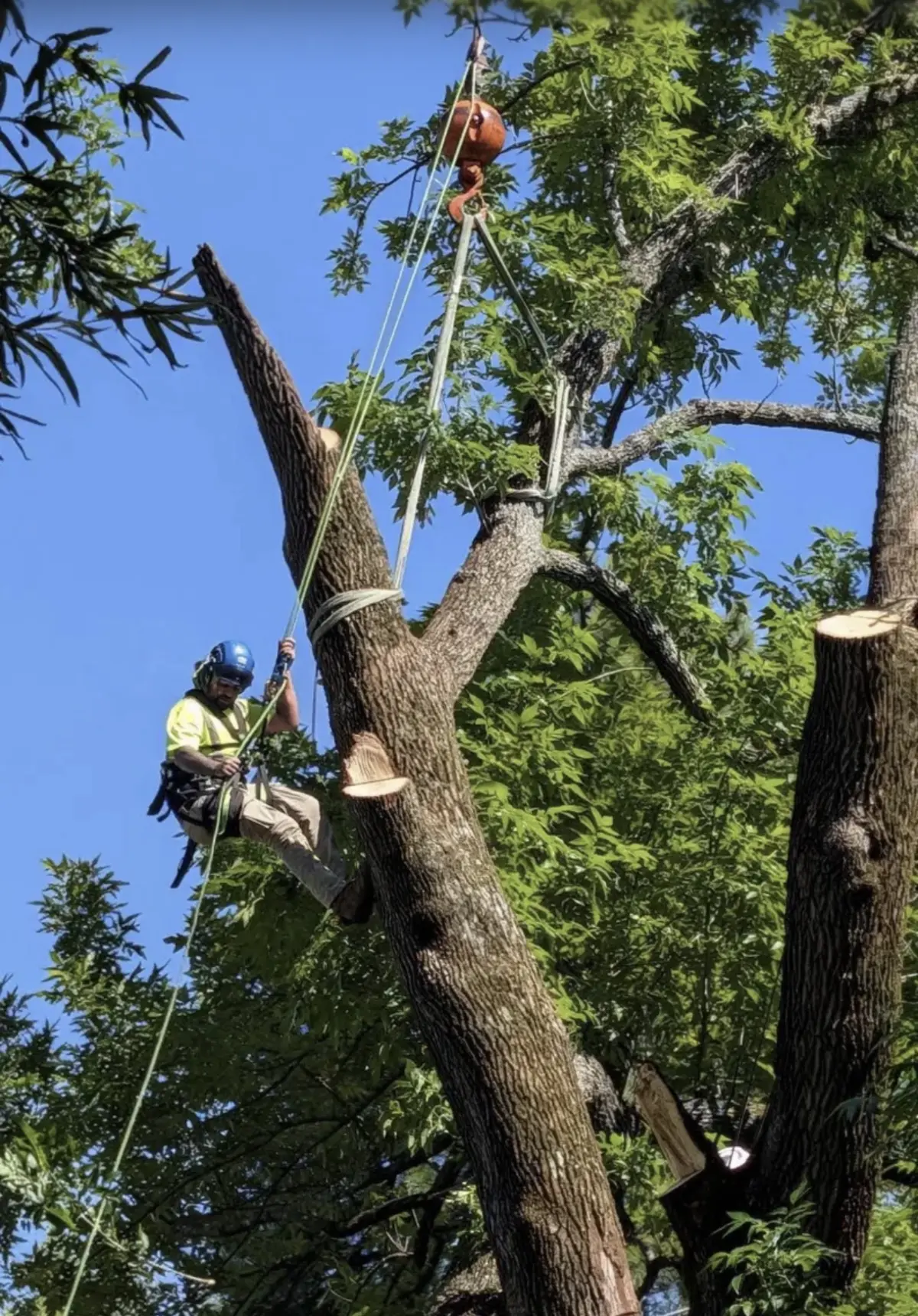
A family’s tree at the water’s edge
The property that stuck with me had been in the same family for over a hundred years — the trees on it were basically a living record of that. The call was mostly about one big, aging hardwood near the water. The owner was worried about it in storm season, and there was real sentiment attached to it. Those are the good conversations to have; you’re helping someone protect a place that means something.
We walked the whole property before quoting a thing — that’s standard for us. When we did, we confirmed the lot sat inside a Chesapeake Bay Preservation Area. Some of the trees were straightforward: they stood in the RMA, and the removal applications for them went through routinely with the right documentation. The trees closest to the water were the hard part.
Up close, a couple of those waterside trees genuinely had issues — some decline, some deadwood hanging over the yard — but “worth taking seriously” and “legal to remove” are two different questions inside a buffer. I’ve seen what happens when a crew treats them as the same question: it’s the homeowner left holding the violation, not the outfit that already cashed the check. So we slowed down and sorted every single tree into the right bucket before a saw ever came out.
How we kept it legal and still solved the problem
For the trees inside the most restrictive buffer, I didn’t try to force a removal through. Instead we did careful, ANSI A300–standard crown reduction and deadwood removal on those specific trees — taking weight off and cleaning them up without clearing them out of the buffer. We climbed them spikeless, so we weren’t wounding protected trees on the way up.
For the trees that genuinely needed to come down and sat outside the strictest buffer, we handled the RMA permitting properly and removed them in full compliance. The homeowner got the safety and the peace of mind they were after, the buffer stayed intact, and nobody was exposed to a five-figure penalty. That’s the whole game on waterfront work: solve the actual problem inside the rules, not around them.
“On the water, the cheapest quote is often the one that hands you the fine. Compliant work is the value.”
Those buffer trees are doing real work
It’s easy to see the buffer as red tape until you look at what those trees actually do. In its natural state, that 100-foot strip filters stormwater before it reaches the water, traps sediment and pollutants, and holds the bank together. Pull the trees out and you lose all of it — the runoff, the erosion, the nutrients all go straight into the Bay.
And the numbers back it up. Chesapeake Bay Program modeling estimates that the practices put in place between 2009 and 2024 cut nitrogen entering the Chesapeake Bay by about 15% and phosphorus by roughly 22%, and met the sediment reduction goal.2 A big share of the sediment and phosphorus reductions came specifically from the natural sector — trees, forests, wetlands, and shorelines, exactly the vegetation the CBPA protects.2 That tree in your buffer isn’t just yours; it’s doing a job for the whole Bay.
What this means for waterfront owners
If your property backs up to the water anywhere in Hampton Roads — Virginia Beach, Norfolk, Chesapeake or Portsmouth — assume the Chesapeake Bay Preservation Act touches it and check before you cut. A licensed, insured crew that works these lots regularly can tell you which zone your trees are in, what’s allowed, and how your specific city handles approvals — and can usually find a compliant way to get you the safety and the sightlines you want. That’s the difference between a tree job and a code violation.
Sources
1. Virginia Department of Environmental Quality, “Chesapeake Bay Preservation Act.”
2. Chesapeake Bay Program partnership, Watershed Model progress estimates, 2009–2024. City penalty and board details per the Virginia Beach City Code (Appendix F) and Norfolk City Code.
Let’s figure out what’s actually allowed.
We’ll check whether your lot falls in an RPA buffer, tell you honestly what can and can’t be done, and handle any permitting properly. The estimate is free.
Get a Free Estimate