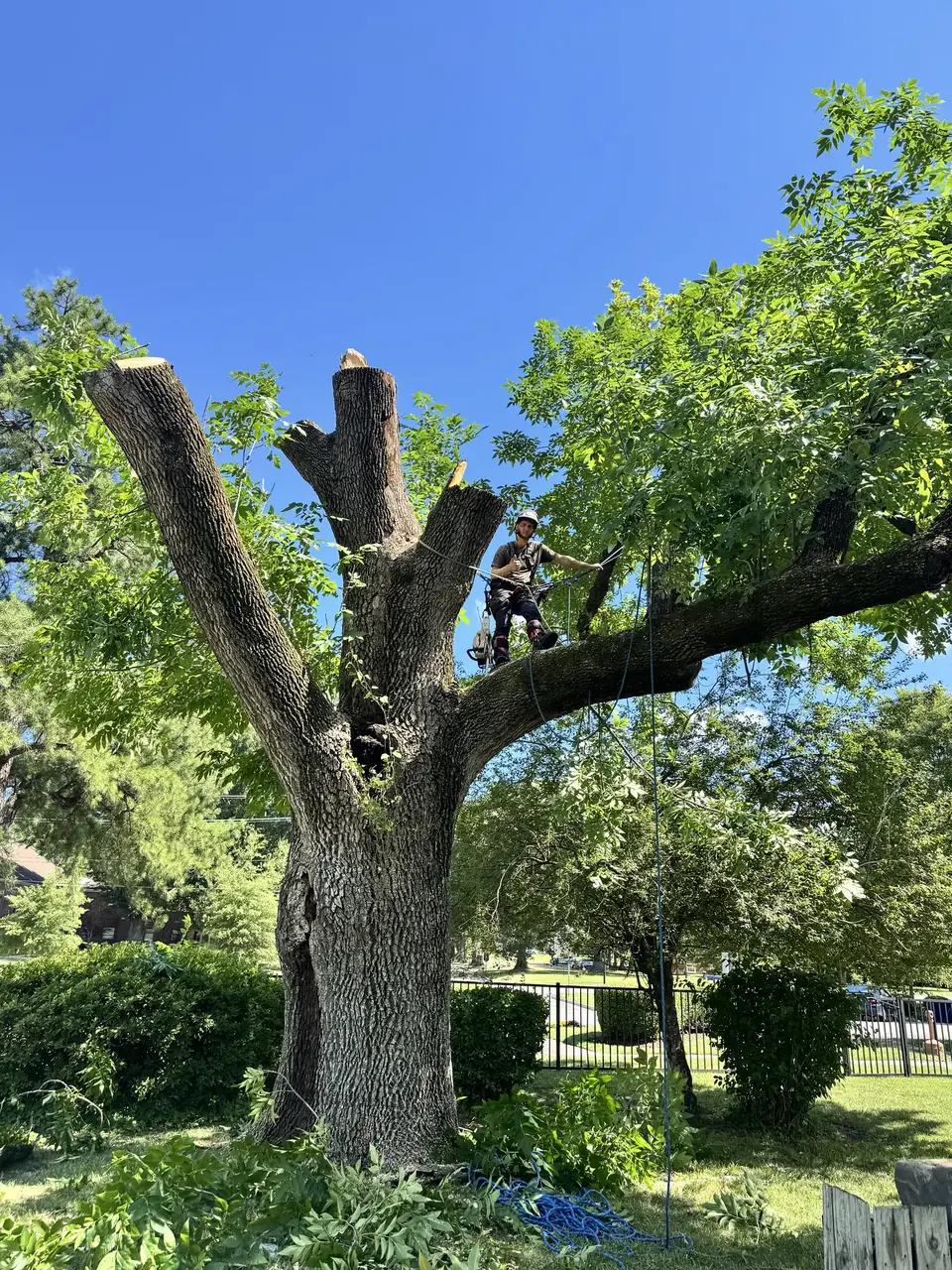
The 200-Year-Old Church Ash
By Mike Campbell, Owner & Lead ClimberPublished
- Location
- Church property, Kempsville, Virginia Beach
- The tree
- A ~200-year-old ash, roughly 4 ft across at the union
- Diagnosis
- Emerald ash borer — rapid, fatal decline
- The hazard
- Rotten co-dominant union held by a steel cable, over an altar, a fence, and the day-school play area
- Method
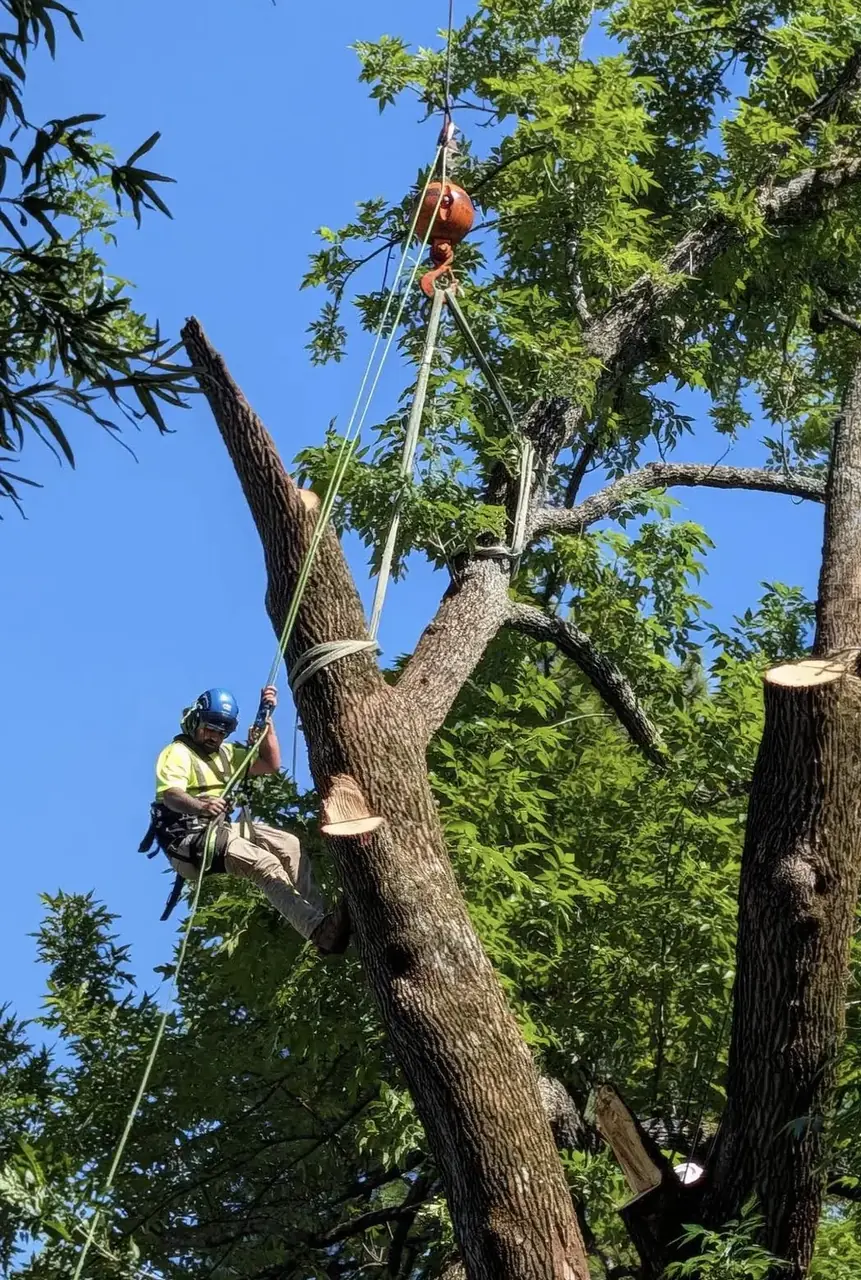
- Crane-assisted removal, rigged before every cut
- On record
- Corroborated by owner Melissa Thomas’s 5-star review
This is one I won’t forget
I’ve taken down a lot of trees in my years climbing around Hampton Roads, but the big ash at the church in Kempsville is one that stuck with me. It was close to two hundred years old — older than most of the buildings around it — and by the time the church called us, it was dying fast. The people there loved that tree. Nobody wanted to lose it. But once I walked the property and got a look at what was really going on, there wasn’t a decision to make. That tree had to come down, and it had to come down carefully, because of what was sitting underneath it.
Directly below the canopy was an outdoor altar the congregation uses, a fence line, and — this is the part that mattered most to me — the play area for the church’s day school. Kids play under that tree. So this wasn’t just a tree job. It was a hazard sitting over the exact spot you least want a hazard.
Every telltale sign of emerald ash borer
The emerald ash borer is a small metallic-green beetle that has quietly wiped out ash trees across the country, and this ash had the whole checklist. The first thing you notice is canopy dieback — the top of the tree thins out and whole branches die while the rest is still leafing. Virginia Cooperative Extension calls canopy dieback the first indication of an emerald ash borer problem, and up in that tree it was obvious.1
From there it was the rest of the signs. Pale patches on the bark where woodpeckers had been stripping it to get at the larvae underneath — arborists call that “blonding.” The D-shaped exit holes, about a quarter inch, where the adult beetles chew their way out. Peel back a piece of dead bark and you find the S-shaped tunnels the larvae carve through the layer that keeps a tree alive.1 Those tunnels are what kill it — they cut off the tree’s ability to move water and food, and once enough of them ring the trunk, the tree starves from the inside out.
That’s why an ash goes downhill so fast. A heavy infestation can kill a mature ash in as little as three years, and emerald ash borer attacks every species of ash we have in Virginia.1 This one was well past the point where treatment made sense.
A rotten union, hanging by a thread
The thing that made this tree dangerous wasn’t just the beetle — it was where the beetle’s damage lined up with an old structural weak point. The ash had a co-dominant union, where two massive leads grew up side by side instead of one central trunk. That union was easily four feet around. There was so much decay hollowed out at the crotch that you could literally fit your leg through the gap in the tree.
The only thing holding that whole lead in place was a steel support cable someone had installed years earlier — a cable brace up in the canopy meant to keep the two leads from splitting apart. That cable was doing exactly its job, and it had probably been doing it for a long time. But the wood it was anchored into was rotting out from the emerald ash borer and age. In my honest opinion, if that cable hadn’t been there, that lead would have come down on its own — on a windy afternoon, in a storm, whenever. It was hanging by a thread.
Why this one had to be a crane job
Here’s the problem the cable created. That steel cable was the only thing keeping the rotten lead up — but I couldn’t take the lead down without dealing with the cable, and the second you cut a cable that’s under load, whatever it was holding goes. If I’d cut that cable with the lead still attached to the tree, the whole thing would have dropped straight down onto the altar and the fence underneath it. That’s not a risk you take with a congregation’s altar and a children’s play area sitting right there.
So we brought in the crane. The crane let us take the weight of that lead before anything got cut — we rigged it, the crane took the load, and only then did we make the cut and relieve the cable. Instead of gambling on where a rotten, two-ton limb would fall, we lifted it straight up and away, over the roofline and out to a clear drop zone where the ground crew could process it. Every piece came off that tree the same way: rig it, let the crane hold it, cut it, fly it out. Nothing was ever dropped.
This is the same reason the USDA notes that emerald ash borer–infested trees in cities and near buildings are usually removed rather than treated — once they’re this far gone, they’re a danger to people and property.2 Removal was the safe call. The crane was how we made it a safe removal.
Careful work, clean finish
We took the tree down piece by piece with the crane, keeping every section under control the whole way. The altar never got touched. The fence never got touched. By the end of the day you honestly couldn’t tell we’d run a full crane removal in that yard — everything was cleaned up and hauled off. The next morning we came back, ground the stump down below grade, spread fresh soil, and seeded the bare spot so the grass would come back in.
I don’t have to take my own word for how it went, because the property owner wrote it down. Here’s part of Melissa’s review of that exact job:
★★★★★“Art-is-Tree came out to provide a proposal for pruning many trees around our church property and the removal of a 200-year-old ash tree in our church yard… By the end of the day everything was cleaned up as if they’d never been there, and they returned the next morning to grind down the stump, spread new soil, and seed the area. They were very careful not to damage an altar that sits under the tree canopy.”
Hazard removed
A lead that could have failed at any moment is gone — off the altar and the play area for good.
Nothing damaged
Altar, fence, and landscaping all came through untouched.
Ground restored
Stump ground out, soil spread, and the area re-seeded the next morning.
What this means for Virginia Beach homeowners
Emerald ash borer is not a maybe anymore — it’s here, and it has already killed hundreds of millions of ash trees across North America, with billions more at risk.2 If you have an ash on your property in Virginia Beach, Kempsville, or anywhere in Hampton Roads, it is almost certainly on borrowed time unless it’s being treated. The tricky part is that an ash can look mostly fine one season and be a genuine hazard the next, because the damage is happening inside the trunk where you can’t see it.
What I tell people is simple: if you’ve got an ash and you’re seeing dieback in the top, bark blonding, or those little D-shaped holes, get it looked at before it becomes an emergency. Caught early, some ash trees can be treated. Caught late — especially a big one over a house, a driveway, or a play area — it becomes a removal, and often a crane removal, because a dead ash gets brittle and unpredictable. We’ll come out, tell you honestly which one you’re looking at, and never charge you for the estimate.
Sources
1. Virginia Cooperative Extension / Virginia Tech, “Emerald Ash Borer: Options for Landowners.”
2. USDA Animal and Plant Health Inspection Service (APHIS), “Emerald Ash Borer.”
Get it looked at before it becomes an emergency.
If you have an ash showing dieback, blonding, or D-shaped holes in Virginia Beach or Hampton Roads, we’ll come assess it and give you a straight answer on tree removal. The estimate is free.
Get a Free Estimate